
OWA IPB Introduces Easy Ways to Get Data without Going Down to the Field
Writing a thesis among students is often constrained by the data they have to collect. The problems range from data incompatibility with literacy to the use of incorrect collection methods. Taking data to the field sometimes is rarely done by students because of constraints of distance and funds.
Therefore, the Wahana Alam Observation Community (OWA), under the Biology Student Association, Institut Pertanian Bogor (IPB) invited Tambora Muda, a community that makes data sources centralized, reliable and up to date. Students no longer need to look for data into the field, because the data can already be accessed via the internet.
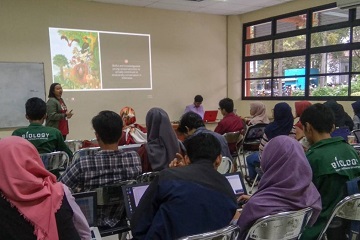
To socialize these findings, the two held a workshop entitled “Biodiversity Occurrence Data & Its Application” which was held in the Reading Room of the Department of Biology, Faculty of Mathematics and Natural Sciences (FMIPA), Campus of IPB Dramaga, Bogor (15/12). This workshop aims to introduce the processing of data on biodiversity to students.
Tambora Muda itself is a community that cares about information on biodiversity circulating in the community. This community is a gathering place for all young people who are interested in Indonesian conservation. Some of the things that have been done by Tambora Muda are writing checks, magazine publishing, and organizing seminars and workshops.
According to Pramita Indrarini, Head of Public Relations at Tambora Muda, access to biodiversity data is increasing year by year. The Global Biodiversity Information Facility (GBIF) is an international organization that focuses on information about biodiversity and is one of the trusted data sources. In addition, according to him, another reliable source that can be used as biodiversity data is a thesis of students. However, taking the data from the thesis has a problem that most students do not have the confidence to submit their thesis into a paper or journal.
“Not everyone wants to publish their thesis into a paper or journal. As a result, their thesis is difficult to access. Tambora Muda deals with this by holding a Biodiversity program. That is collecting student thesis as data on diversity in Indonesia. We are now testing the website,” he said.
This event not only introduced the importance of biodiversity data but also trained participants (IPB students) how to process data using the site from GBIF as a data source. It is intended that students are not confused anymore in finding research data, especially in the field of biodiversity.
“In this way, we don’t need to bother to go to the field to look for data,” he said. (NR)

