
Members of Bahrain’s Royal Family Come to IPB Talk about the Importance of Halal Supply Chain Management
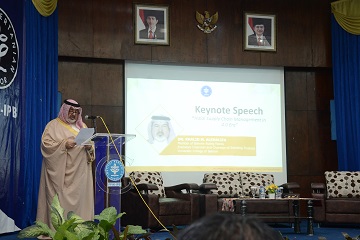
The halal industry is now gaining high attention in the international community. The demand for halal products does not only come from Muslim countries but also from non-Muslim countries. Therefore, discussions about the halal supply chain are very necessary.
This was conveyed by Dr. Khalid Alkhalifa, a member of the Bahrain Royal Family and Executive Chair and Chair of the Supervisory Board, University College Bahrain when he was the Keynote Speaker at the International Islamic Economics Seminar, IPB Department of Islamic Economics, at the Dramaga Institut Pertanian Bogor (IPB) Campus (10/12 )
Dr. Khalid gave an example in the food industry, for example, the production aspect became a focal point because the process included ingredients, cleanliness and food mixing.
“Food and services are not enough just for halal, but also must be in good condition for consumption and halalan toyyiban. “Halalan toyyiban includes cleanliness, quality, logistics and security,” he said.
Dr. Khalid also stressed that the concept of the halal supply chain should be introduced not only in the food sector, but also in other sectors such as cosmetics, pharmaceuticals, financial services, even tourism and other recreational products.
Meanwhile, Dr. Sutan Emir Hidayat, Dean of the School of Business, Bahrain University, said that consumers currently not only want halal products, but also halal in the process. “In other words, halal must be from upstream to downstream, starting from the production process to the consumers,” he said.
Dr. Sutan explained that Bahrain is currently a Muslim country focused on developing the halal industry. This is evidenced by Bahrain’s ranking in the State of the Global Islamic Economy Report 2018. In this report issued by Thomson Reuters, Bahrain is in the top 10 position for Islamic finance, halal medicines and cosmetics and the halal media sector. The Islamic finance ecosystem in Bahrain is also the second best after Malaysia.
According to him, this is because Bahrain received full support from the government. If Indonesia wants to develop and become the center of world Islamic finance, then the role and support of the government is absolutely necessary.
One form of support for the Bahraini Government in halal tourism is that the government has announced several tourism projects available to private investors as public-private investment opportunities.
Meanwhile, Dr. Sutan Emir Hidayat, Dean of the School of Business, University of Bahrain who attended said that at present, consumers do not only want halal products, but also halal in the process. In other words, halal must be from upstream to downstream, starting from the production process to the consumers, “he said.
Besides Bahrain, Malaysia is currently ranked first in the Global Islamic Economy (GIE) Indicator in the Thomson Reuters report and is number one in halal food, Islamic finance and halal tourism.
Prof. Dr. Irwandi Jaswir, Director of the International Institute for Halal Research and Training (INHART), International Islamic University Malaysia (IIUM) said that halal is a new source of economic growth.
Prof. Iswandi Jaswir is an alumnus of Food Technology of IPB, the recipient of the prestigious “King Faisal International Prize 2018” award submitted directly by King Salam bin Abdul Aziz Al Saud in Riyadh, Saudi Arabia, last March or a major contribution in the development of Halal Science, which thanks to his discovery Islam in detecting illicit elements in food or other products such as drugs and cosmetics. Many people later dubbed him “Professor of Halal”.
According to him, Malaysia’s success in the halal industry is because Malaysia has a complete halal ecosystem covering production, services, infrastructure, human resource capacity and government support.
In this seminar, the Indonesian government tried to support the halal industry delivered by Prof. Bambang Soedibyo, as Director of the National Zakat Amil Agency (BAZNAS). Prof. Bambang said, BAZNAS provided financial and technical support for many small entrepreneurs in the production and marketing of halal products through the mustahik empowerment program, one of which was microfinance for entrepreneurial mustahik.
Meanwhile, Vice Chancellor for Cooperation and Information Systems of IPB, Prof. Dr. Ir. Dodik Ridho Nurrochmat M.Sc. F.Trop said that as a university, IPB also paid special attention to this halal issue and about how to improve halal agroindustry issues in general.
“For example, IPB and experts have been actively involved in halal issues such as research, innovation, business incubators and others. Even IPB has a halal research center that has special duties in halal matters. This is because we recognize the importance of this problem, “he said.
The seminar which was initiated by the Department of Islamic Economics of IPB and the Center for Business and Syari’ah Economic Studies (CI-BEST) was also attended by Dr. Tawat Noipom, Director of Halal Institute, Prince Songkla University Thailand, Prof. Sukoso Head of BPJPH, Ministry of Religion of the Republic of Indonesia, Prof. Khaswar Syamsu, Head of the IPB Halal Study Center, and Riko Wardhana, Group Head of Digital Banking, Bank Syariah Mandiri. (NR)

