
Collaboration of IPB and PT. RNI to Increase the Competitiveness of the Sugar Industry in the Industrial Era 4.0
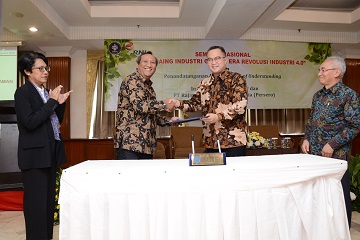
Bogor Agricultural University (IPB) cooperates with PT. Rajawali Nusantara Indonesia (RNI) Persero in holding a National Seminar with the theme "Competitiveness of the Sugar Industry in the Industrial Era 4.0" at the Salak The Heritage Hotel, Bogor (23/8). This seminar featured the Special Staff of the Staff Office of the President of the Republic of Indonesia, Avanti Fontana, PhD, as the keynote speaker. In addition, there were also three other speakers, namely the Rector of IPB, Dr. Arif Satria, President Director of PT RNI, B. Didik Prasetyo, and Special Staff to the Indonesian President for Economics who is also a Lecturer at the Faculty of Economics, Brawijaya University, Prof. Dr. Ahmad Erani Yustika. The seminar was attended by the directors of subsidiaries of PT. RNI (Persero), the directors of related State-Owned Enterprises (SOEs), lecturers, IPB Alumni Association, students and practitioners.
On this occasion, Avanti said that the industrial revolution 4.0 is not only an opportunity to increase productivity and competitiveness, but also a big challenge because not all industries are ready to face these major changes. The same thing happens to sugar productivity in Indonesia where in fact the problem of the sugar industry in Indonesia is quite complex. Over the past several decades, sugar productivity in Indonesia was stagnant because it did not experience a significant increase.
"The problem is not only on the level of on-farm but also off-farm. In addition, there is a commodity or market dualism and an inefficient trade system. As a result, the level of efficiency and productivity of the sugar industry is low and not competitive. Moreover, the problems of imports, availability of stocks and other matters related to regulations that are deemed to be ineffective and inefficient also occur. These various matters become serious problems that can affect the competitiveness of the national sugar industry," he said.
On the other hand, current world industrial development has shifted to the industrial era 4.0. This industrial era is marked by very rapid changes in the digital era. The Indonesian government through the Ministry of Industry has prepared a road map called Making Indonesia 4.0. The road map is prepared in order to implement a number of strategies to enter the Industrial Era 4.0. There are five main sectors that are focused on the initial application of technology to face this era, one of which is the food and beverage sector where the sugar industry is included in it. Implementation strategies developed for the food and beverage sector are integrated with the use of advanced technology which is the main characteristic of the industrial era 4.0.
The existence of a Making Indonesia 4.0 road map makes the sugar industry in the country with all its complex problems must inevitably be able to adjust and change following the development of the industrial era 4.0. Therefore, the National Seminar on "Competitiveness of the Sugar Industry in the Industrial Era 4.0" was held to explore more deeply the readiness and competitiveness of the sugar industry in the era of disruption.
Meanwhile, the IPB Rector, Dr. Arif Satria, said that the strategy to increase the competitiveness of the sugar industry in the Industrial Revolution 4.0 era can be carried out through information technology and communication innovations or Information Communication Technologies (ICT) in various aspects of the sugar industry, ranging from aspects of production, supply chain linkages, investment, to aspects of integrated research. Agriculture in the revolutionary 4.0 era will continue to grow with digital technology that continues to advance in the form of the use of drones and robots that utilize massive artificial intelligence upstream of the agricultural sector.
"In addition, the sugar industry problem is more on social issues, so what is needed is education through farmers mentoring. The farmers will know how to grow sugar cane properly, so that later they can produce an abundant sugar cane to support national sugar production. If the industrial revolution 4.0 is implemented in the national sugar industry, then it must be accompanied by an increase in the partnership pattern among the farmers and companies in order to create a positive improvement with justice and mutual support," said the Rector of IPB.
President Director of PT. RNI, B. Didik Prasetyo, explained that there is still plenty of room for increasing competitiveness and innovation in the sugar industry. Every part of the sugar cane plant such as the shoot, dried leaves and stem, can be processed into various products that have high economic value. The President Director of RNI also said that in order to deal with Sugar Industry 4.0, sugar cane cultivation must be developed with an integrated system from upstream to downstream through the utilization of the Internet of Things (IoT) and Artificial Intelligence (AI). The mindset must also Go Beyond the sugar industry. Therefore, it is necessary to carry out operational innovations in the sugar cane industry, both on-farm and off-farm, and other aspects outside the sugar industry.
"Problems and conflicts in the national sugar industry are possible to be solved and its solutions can be founded. The role of technology in facilitating connectivity and access to big data which is one of the characteristics of industry 4.0 can be used as a tool to make the sugar industry more effective and efficient so as the competitiveness can be improved. In addition, cooperation between various parties is certainly very necessary in order to form synchronization and integration in various processes of the national sugar industry ranging from upstream to downstream," he said.
Prof. Dr. Ahmad Erani Yustika said that one thing needed to be done is a significant renovation of the sugar trading system in Indonesia. In the future, the national sugar industry can be better prepared to adjust itself to the Industrial 4.0 era so that it can boost competitiveness and regain success at the global level.
The seminar continued with the signing of the Memorandum of Understanding (MoU) by IPB and PT Rajawali Nusantara Indonesia (Persero) (RNI). This collaboration is to synergize the industrial world and universities to improve the competitiveness of the sugar industry in the industrial 4.0 era. This cooperation is carried out as an effort to strengthen science and technology by utilizing the potential of existing resources which include the fields of education, research, development of innovation, commercialization of innovation, teaching industry, and community service. The signing of the MoU was carried out by the Rector of IPB, Dr. Arif Satria, and President Director of RNI, B. Didik Prasetyo.
Not only limited to the use of research results, Didik hopes in the future RNI can contribute more in supporting the progress of the country's education through a certified internship program. IPB students, especially those with academic backgrounds which are in line with the RNI (agro-industry) business line, can do internships or research programs in each RNI business unit. (Awl/ZSP/Zul)

