
Heading to the Green Campus, IPB Needs an Analysis of the Energy Used by Each Unit
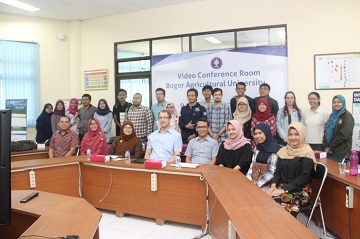
The Green Campus concept has several parameters as a standard measure of success. Bogor Agricultural University (IPB), which is realizing the Green Campus 2020 concept, encounters various problems in its implementation. To find a solution, the Directorate for International Program of IPB held the IPB Talks with the theme 'Complexity and Sustainability Sciences Green Campus'.
The activity held at the IPB Dramaga Campus, Bogor, West Java (18/8) was attended by IPB students. To expand the reach, this activity was presented using an online seminar system (webinar) to be easily listened to by other campus students and the general public.
The event featured speakers from the University of Colorado Boulder, United States, Professor Moncef Krarti. Prof. Moncef is an expert in civil, environmental and architectural engineering. The second speaker was Dr. Aceng Hidayat, who currently serves as Secretary of the Institute (SI). Also present were representative from the Associate Professor of the Department of Resource Economics and Environment of IPB who explained about IPB's efforts in realizing the Green Campus concept. The activity was moderated by Dr. Ulfah Juniarti Siregar, Associate Professor from the Department of Silviculture, Faculty of Forestry, IPB.
According to Prof. Moncef, the largest energy consumption of a unit is in the building, because in the building all primary activities throughout the day take place. For this reason, an analysis of energy use is important for the energy efficiency of a unit. This can be started from a building installation. "We must be able to answer which parts use the greatest energy and how to reduce energy use wisely. It is very good if existing buildings begin to implement a system that is environmentally sustainable which is realized by using the latest technology," he explained when presenting material entitled Planning for Zero-Emission Campus.
Some technologies to support buildings that are environmentally sustainable are through heat flow regulation, the use of energy-saving materials, the application of renewable energy, and intelligent control of electrical installation systems.
Included in the scale of the university campus, the energy use pattern of campus building must be calculated properly and start using sustainable strategies. In his study, the campus can make savings after using various energy efficiency systems in the building. Among these activities is control of air conditioning and lighting settings.
Each unit has different conditions about its complexity and specifications. Applications can be different from each other, so each campus must have data to actualize energy efficiency and Green Campus.
"At IPB, we apply the IPB Smart Building concept but the percentage of implementation is still below 30 percent. Some buildings at IPB have carried out a building construction policy that maximizes natural lighting during the day, however, this has not been applied in all buildings," said Dr. Aceng.
IPB Green Campus also focuses on other aspects summarized in six criteria, namely environmentally friendly regulations and policies, waste management, low carbon energy use, water problems, green transportation, and biodiversity preservation.
The question arises whether IPB has now become a Green Campus. "There is one criterion of Green Campus, namely biodiversity. IPB has showed it with the high biodiversity on the campus. And we continue to work together to realize the other criteria of Green Campus," said Dr. Aceng. (EAW/Zul/ZSP)

