
IPB’s LPDP Awardees Held “Ngabuburit Bareng Bule”
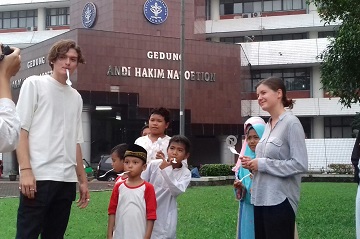
Twelve foreign students of Bogor Agricultural University (IPB) attended “Ngabuburit Bareng Bule 2018” with orphan and poor children from Cikarawang, Dramaga, Bogor in IPB Dramaga Campus (27/5). The event’s name can be roughly translated to “waiting for day’s fast to end with foreigners”. “Ngabuburit” is a Sundanese word which means “seek amusement and distractions while waiting for day’s fast to end” and “bule” is a commonly used word in Indonesia to describe a foreigner. The event was held by the awardees of Indonesian Endowment Fund for Education (LPDP) from IPB and Arrohman Foundation and presented 12 foreign students from Malaysia, Myanmar, Vietnam, Philippines, Japan, and Australia.
The foreign students were Jazlyn Bon Ong Lim Yu and Jizabelle Labrador Berja (Phillippines), Kiyotaka Ikeda and Takahashi Rina (Japan), Khine Thazin Winn (Myanmar), Tran Thi My Hoa (Vietnam), Nur Fatin binti Ismail, Nur Syahirah binti Zainal Abidin, Nor Nadhia binti Che Amdilah, Nur Syafiqah Nadiah binti Mohammad Rafi, and Shahrini bintit Muzakir (Malaysia), Alana Griffiths and Orlando Kirby-Knox (Australia).
“Ngabuburit Bareng Bule 2018” was part of non-formal English education program which is routinely held by Arrohman Foundation and LPDP awardees.
“Every Tuesday, LPDP students teach English in Arrohman Foundation, Cikarawang. In this Holy Month of Ramadhan, besides inviting the children to break the fast together we also invited them to meet foreign students,” said Buchori, Head of Community Service division of IPB LPDP.
According to him, this activity trained the children’s courage to chat with foreigners. Besides, it also increases their knowledge regarding various cultures and arts from other countries. In addition to sharing their knowledge, these foreign students also played games with the children in IPB’s rectorate field. There were relay of marbles and ping-pong ball race.
Jazlyn, a girl from Manila, said there is similarities between Bahasa Indonesia and Tagalog. These similarities eases Jazlyn in communicating during her study in IPB.
“In Philippines it’s karabau, while in here it’s kerbau (buffalo). Ako means aku or saya (me). Many other words are similar with Bahasa Indonesia, but some words sound the same yet have different meaning. Such as harapan kita means aku cinta padamu (I love you) or selamat which means terima kasih (thank you,” she explained.
Meanwhile, Kyoto Ikeda (19), student from Japan, showed art and culture from his country. Kyo also shared his experience of fasting in Ramadhan.
“In Japan, I rarely meet Moslems, there’s a negative image of Islam in there. But ever since I studied in Indonesia and met many Moslems, my view regarding Islam has changed. I even fasted for a whole day, from suhoor to iftar. From the beginning of Ramadhan until now. There’s no special reason, I just want to try it,” said Kyo. He will tell this experience to his family, that Moslems in Indonesia is not like how his family worries about.
Similar thing also agreed by Orlando and Alana, they felt happiness in sharing and knowing Indonesian children. “In Australia, there are many Moslems although I don’t know many of them. In Indonesia I study a lot about Islam, like today I learnt about fasting. Even though I don’t fast, but I respect them,” said Orlando. (RYF)

