Local Wisdom of Dayak Ngaju in Land Preparation Worthy to be an Example
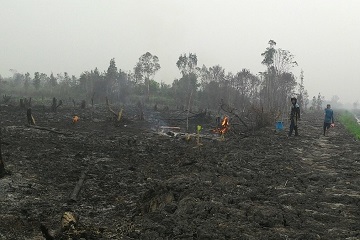
Land clearance by burning often causes adverse effects on humans and the environment, such as smog. However, the burning process is still legalized to date for indigenous or traditional peoples, for example for the Dayak Ngaju community. Prof. Dr. Bambang Hero Saharjo researcher from the Department of Silviculture, Faculty of Forestry Institute of Agriculture Bogor (IPB) explained that there is a way of preparing land using fire (burning) that is by controlled combustion by indigenous or traditional people.
"Land preparation by burning is done because according to them this way more practical and effective, cheap, easy, quick and can fertilize the soil. Land preparation by indigenous or traditional peoples by fire is carried out in a controlled manner as guaranteed by applicable legislation, as stated in UU No.32 of 2009 and explanation of article 17 PP No.4 / 2001, as long as the fire does not jump to non target land," he said.
Land preparation by controlled burning is usually done with local wisdom in every region in Indonesia. The Dayak Ngaju community has a certain rule in the process of land clearing. Research conducted by Erekso Hadiwijoyo who is a graduate student guidance Prof. Bambang Hero Saharjo and Dr. Ir. Erianto Indra Putra analyzing land preparation pattern using fire (burning) by Dayak Ngaju people in Central Kalimantan Province.
In preparing the land, there are two important things that are noticed by the Dayak Ngaju community, namely custom rules and rituals and also techniques used in the burning. The customary rituals performed prior to the burning were in the form of a reverence for the supernatural beings on the field, while the combustion techniques include timing and ordering of combustion. The management and utilization of traditional peatlands or local wisdom is called handel system. In this system there is an organizational structure that is chairman, vice chairman, treasurer, head of body and members.
"Handel system is peatland management in a group on a large expanse of one small river ranging from land location selection, extraction, logging, drying, burning, planting to harvesting. Burning is usually done in August or September according to climatic conditions occurring in that year. If the dry season is longer, the combustion process can be done at the end of September or early October," he said.
The Dayak Ngaju community carried out the burning process in a cooperative manner, all activities were carried out by bargaining. Land preparation is done by making a burning block or a ditch of wood, grass and leaves around 3-6 meters wide land, and punishment Jipen in case of violation of custom rules. All members do burning together at a predetermined time. The best time to burn is when the sun is blazing at 12:00 or 13:00 and the wind is strong. If the environmental conditions do not match then the burning time is postponed and re-agreed.
"Preparation of land by fire is still done by traditional or indigenous people because these activities are part of their life and according to them the absence of other technologies that are considered better. Land burning is done by the community for making the land more productive in order for them to obtain more agricultural (i.e. paddy) crops. Today Dayak Ngaju indigenous people often find it difficult to determine the exact burning time due to climate change," he said. (RYS)