Limited Discussion Organized by CARE LPPM IPB Reveals Cause of the Pollution of Lake Toba
As the government steps up efforts to boost tourism and promote Lake Toba as a prime tourist destination, the iconic North Sumatra lake continues to be marred by water pollution. Pollution in Lake Toba, North Sumatra is caused by various human activities. It was reported that lake’s water had been polluted by various activities such as domestic wastes, illegal logging, livestock, agriculture, industrial waste, keramba (floating net cages for fish cultivation) and the flow of dirty water from nearby rivers. The heaviest pollution occurred near the industrial area, river estuary and areas where keramba are installed. Therefore, pollution control should be the responsibility of all sectors and layers of society.
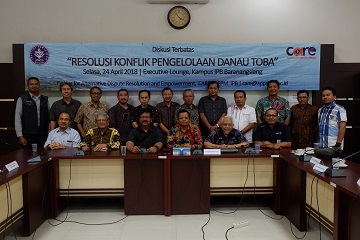
This report was presented in the a limited discussion on "Resolusi Konflik Pengelolaan danau Toba (Conflict Resolution of Lake Toba Management)", carried out in the Meeting Room of Board Trustees, IPB Campus, Baranangsiang, on 24 April 2018. The discussion was organized by the Center for Alternative Dispute Resolution, Regulation and policy (CARE), of Institute for Research and Community Service, of Bogor Agricultural University (LPPM IPB).
"CARE LPPM IPB has an obligation to play an active role in formulating conflict resolution. One of them is Lake Toba, as it is the largest lake in Indonesia which has various functions and intensive use. Various interests have utilized the available resources in the lake Toba, which can cause conflicts because of different criterion needs and sensitivity level of each use. The lake can only provide optimal social benefits if the policy setting management fully recognizes the potential contribution of the lake for the community and the policy is integrated to provide a balanced attention on all the values that the lake can give," said Prof. Rizal Syarief, Chairman of the Advisory Board of CARE LPPM IPB.
There are several government regulations that regulate the quality of water in Lake Toba, including the Decree (SK) Governor of North Sumatra Number 188.44 / 209 / KPTS / 2017 that currently Lake Toba the status is Tropic. This Decree was establishes to decide that Lake Toba is in oligotropic status.
The lake is currently in mesotroph condition due to excessive pollutants, particularly phosphorous waste, which is being blamed on the aquaculture industry and some want the lake to be returned back to its original oligotroph condition. Academicians, however, stated that carrying capacity would be dynamic by time and that the phosphorous waste comes mainly from municipalities’ detergents around the lake. They also asserted that it is impossible to return the lake to its original pristine condition. They suggested that all of these factors be well managed based on scientific findings and regulations.
"With regard to the discourse on the prohibition of fish cultivation using the floating net cage system (KJA), in Perpres no. 81 Year 2014 on Spatial Planning of Lake Toba and Surrounding provide space for KJA in Lake Toba. Nevertheless, there needs to be environmentally friendly cultivation system, not only by big fishing companies but also by KJA fish cultivation in Lake Toba, "he said.
Therefore it is necessary to harmonize data between those resulted by institutions with the real condition of Lake Toba. Currently, data on Lake Toba pollution produced by government institutions are different, yet those data will be utilized as the reference decision-making. In addition, participants also agreed that universities played a key role for the settlement of conflict in Lake Toba because of its neutral position and more acceptable to all parties.
Participants of Limited Discussion were from various institutions including fisheries and water sector researcher, representative of Ministry of Tourism, Ministry of Environment and Forestry, Ministry of Maritime Affairs and Fisheries, Authority Agency of Danau Toba, Tourism and Culture Office of South Tapanuli Regency, fishery company in Toba lake, graduate student of IPB, and researchers of CARE LPPM IPB. (Wied)