IPB’s Tribute for National Cassava Development
Cassava is an important agricultural commodity that is widely used for food, feed, and industries. However, this commodity has received less serious attention in Indonesia as reflected by the high import value of cassava. In recent years Indonesia has imported cassava in the form of chips and tapioca.
A research team in Bogor Agricultural University (IPB) is focusing in cassava research, from lab-to-consumer. The research team’s leader, Dr. Nurul Khumaida, explained the cassava research road-map in IPB which aims to develop cassava superior variety, high quality seedlings, and cassava-based products.
Cassava breeding program in Indonesia is still very limited due to the cross-pollinating nature of cassava. In order to develop cassava superior variety, the research group used mutation breeding approach. Dr. Nurul Khumaida together with her teammates, Prof.Dr.Muhammad Syukur and Dr.Sintho Wahyuning Ardie, started the gamma-rays cassava breeding project in 2014, involving many graduate students funded by the Ministry of Research, Technology and Higher Education of Indonesia. The project continuously receives research funding from various schemes. Over 100 variants of irradiated cassava were evaluated. In 2018, there are 48 potential cassava mutants ready for multi-location trials. These mutants have high-yielding and high-starch content potentials. Cassavas with low HCN (cyanide acid) content are selected for food products and the ones with medium-high HCN content for industrial purposes.
In cassava cultivation for industrial purposes, farmers are still constrained with limited high quality seedlings. To support continuous cassava seedlings supply, the research group developed in-vitro technique for cassava seedlings mass propagation. This technique provides uniform, vigor and virus free seedlings rapidly without any change in the genetic information, thus it is very suitable to support the nursery industries.
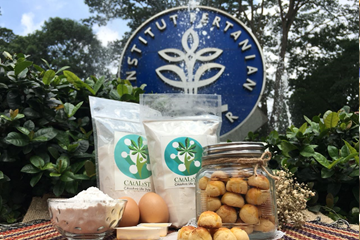
The research team is also actively promoting cassava to societies by establishing a cassava lover community called Catalyst (Cassava life style). This community is bridging the research results to societies. The Catalyst provides variety of training programs related to sustainable cultivation of cassava, cassava post-harvest and processing, cassava-based products development, and seedlings production using in-vitro techniques. The Catalyst also published training modules and online courses related to cassava. In the international level, the research team is also actively participating in Asian Cassava Breeders Network (ACBnet) since 2016. Dr. Nurul Khumaida was assigned as Indonesia’s representative in a steering committee for ACBnet in 2017.
In collaboration with the food scientist, Prof.Y. Aris Purwanto and Prof. Slamet Budijanto, this research team has put added value to their cassava-based products to improve the products’ economic value. In 2017 the research team was awarded CPPBT grant scheme (a potential new technology-based company) to support their cassava-based company initiation. In 2018, the research team is awarded the PPBT scheme (technology-based start-up companies) to strengthen their cassava-based start-up company. Not only focusing in cassava research, the Catalyst starts their own cassava-based products business with the name of Catalyst Agro Innovation. We can expect new cassava superior varieties, sustainable cassava seedlings supply, and cassava-based products development will strengthen the national cassava industries (SWA/FR).