IPB Organized Public Lecture of Nanotechnology and Biosensor for Food Safety in Food Quality
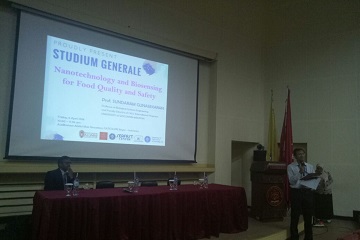
Department of Food Science and Technology, of Bogor Agricultural University (IPB), in cooperation with Southeast Asian Food and Agricultural Science and Technology Center (SEAFAST) of the Institute for Research and Community Service of Bogor Agricultural University (LPPM IPB), and Wisconsin Alumni Association organized Studium Generale on “Nanotechnology and Biosensor for Food Quality and Safety”, at the Auditorium Abdul Muis Nasution, IPB Campus, Dramaga, on Friday, 6 April 2018. This Studium Generale was attended by 90 participants from various institutions including undergraduate students of Food Science and Technology, students of the Graduate Studies program of the International Food Technology Profession, of the International University Liaison Indonesia, Polish Warsaw Exchange students, Food and Drug Supervisory Agency (BPOM) and also some students from the Faculty Fisheries and Marine Sciences and Nutrition Science Program IPB.
Professor Chair Holder on biological systems engineering, of University of Wisconsin-Madison, Prof. Sundaram Gunasekaran, present as keynote speaker in this special event. The Studium Generale was moderated by Prof. Dr. Purwiyatno Hariyadi (Vice Chair of Codex Allimentarius, Senior Scientist Seafast Center of IPB) who is also an alumni from Wisconsin University. In addition to providing an overview of how the University of Wisconsin and its work in the world of research, this Indian Professor presented many interesting facts and research related to food security.
"The data showed that from 2014 through 2015, Indonesia experienced to have the highest rejection rates of fishery products, especially tuna, in the US market because of their poor quality, as about 36 percent of them contained Salmonella bacteria. The studies revealed that 21 percent of food insecurity was due to shipments, 39 percent was due to household factors, and 20 percent was due to the food presentation," Prof. Guna said.
He added, to facilitate consumers in distinguishing whether a food worth consuming or not is the presence of color indicators. Awareness does not necessarily mean that the consumer must be able to recall a specific brand name, but he or she must be able to recall sufficient distinguishing features for purchasing to proceed. The nanotechnology methods will be the appropriate answer for it. Owing to the presence of unique properties in nanoscale materials, the sensing devices can be designed to enhance sensitivity, reduce detection time, and enable multiplexing capability. The nanoscale can detect the presence of microbes or microorganisms in foods by giving certain colors on a simple test.
"The proper test system whether or not the food should be Simple, Rapid and Sensitive. Microorganisms love to live in a living human condition. This is what makes us need to be more vigilant. Therefore, gelatin as one of the most commonly used and safe food ingredients is used as one of the media in detecting color. Temperature conditions also become one of the considerations in the test because the cold conditions make microbes tend to slow to grow, "he said.
Prof. Guna expected that consumers to be smart in choosing food. Food safety is receiving heightened attention worldwide as the important links between food and health are increasingly recognized. Improving food safety is an essential element of improving food security, which exists when populations have access to sufficient and healthy food. Each country should pay attention to food safety, because in the United States alone the death toll from food insecurity exceeds 10 thousand people per year.
Special guests appeared in the meeting, among others were the Head of SEAFAST Center of LPPM IPB, Prof. Nuri. Andarwulan, the Secretary of the Center, Dr. Puspo Edi Giriwono; Head of Cooperation and International Relations of IPB, Dr. Ing Dase Hunaefi; the Food and Safety of Food Coordinator of SEAFAST Center of LPPM IPB, Dr.-Ing Azis B Sitanggang; Researcher of the Department of Food Science and Technology, of the Faculty of Agricultural Technology, Prof. Dr. Hanny Wijaya, and President of the Alumni Association of Wisconsin Indonesia, Jemmy Chayadi. (Wied)