
The Involvement of IPB Research Team on Fisheries Research Project in Raja Ampat
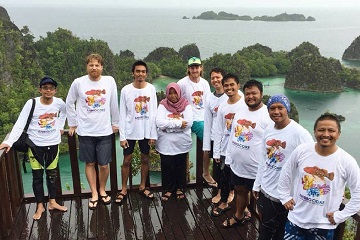
Located off the northwest tip of Bird's Head Peninsula on the island of New Guinea, in Indonesia's West Papua province, Raja Ampat, or the Four Kings, is an archipelago comprising over 1,500 small islands, cays, and shoals surrounding the four main islands of Misool, Salawati, Batanta, and Waigeo, and the smaller island of Kofiau. The Raja Ampat archipelago is the part of Coral Triangle which contains the richest marine biodiversity on earth. Raja Ampat has always been an attraction for dive, conservation and researchers. The region with the highest marine biodiversity in the world becomes a magnet for many people in Indonesia even in the world. A group of researchers of the Faculty of Fisheries and Marine Sciences of Bogor Agricultural University (FPIK IPB), in collaboration with the University of Rhode Island (URI), have conducted a study in Raja Ampat in January 2018.
The title research is Animal Biotechnology and Coral Reef Fisheries (ANBIOCORE), and it is funded by USAID through the USAID SHERA scheme. Researchers of IPB, Dr. Hawis Madduppa, said the research was carried out with the aim to see the coral reef fishery activity and its relation to the marine protected areas in Raja Ampat. The research scheme also involves three other universities, namely Udayana University of Bali, Mataram University of Lombok, and Manokwari University of Papua.
"We found interesting facts about Raja Ampat. It is an archipelago comprising over 1,500 small islands, cays, and shoals surrounding the four main islands. Fish resources are still well preserved, especially in marine protected areas and areas frequented by tourists. The Coral Triangle is the heart of the world's coral reef biodiversity, making Raja Ampat quite possibly the richest coral reef ecosystems in the world. And diversity of Raja Ampat is considerably greater than any other area sampled in the Coral Triangle" said Drs. Hawis Madduppa, who is also Head of Biodiversity and Biosystematika Marine Laboratory of IPB.
He said that on this occasion the group also conducted research related to Environmental DNA (E-DNA), and analysed the stomach contents of several of the fish species to investigate the types of coral reefs and food network. The information collected will be useful for the management marine fisheries in the future. (Wied).

