
Study by IPB Research Group on Jakarta Bandung Conurbation: Large-Scale of Rice Field Depletion In 2005-2010
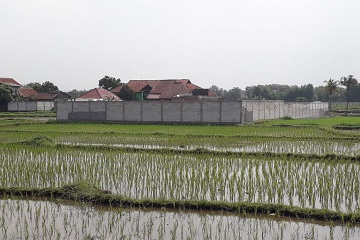
Conurbation refers to a specific kind of geographical region. Due to rapid increase in population and industrial and technological development, the city boundary expands and one urban centre coalesces with another in a slow but continuous process of urbanisation and regional development. It is thus that conurbations are formed. Conurbations are associated with a specific stage of urban development. Urban centres that have poor contact with neighbouring towns in their initial stage of growth may later emerge as conurbations due to developments in industries, trade and transport. Conurbations are growing at a rapid rate in Indonesia and other parts of the world and this has become a cause of concern. The frantic growth results in lack of proper infrastructural facilities and civic amenities to cater to the entire population. Yet in certain areas, two metropolitan areas may become connected to the physical development of buildings that occur along the path that connects the two metropolitan cities. This phenomenon occurs between the City of Jakarta and Bandung, especially with the existence of Cipularang toll road as its connection.
Jakarta as well as other Asian megacities is still experiencing continuous growth and facing various problems that have not been obtained by other major cities in the world. One form of the urban expansion of Jakarta Megacity is the ongoing expansion along the main transport route linking Jakarta to the metropolitan Bandung within 120 km from Jakarta. The conurbation between these two centers has led to the conversion of agricultural land and changes in environmental quality. The tendency of conurbation in this corridor, triggered by industrial development and cluster housing, will increase to uncontrollable. Therefore, it is necessary to understand the consequences of the escalation development that occurred along the Jakarta-Bandung corridor as a precaution against the negative impact.
A group of researchers, namely Ernan Rustiadi and Andrea Emma Pravitasari from the Center for Planning and Regional Development (P4W) of Institute for Research and Community Service (LPPM) – IPB, together with Yudi Setiawan from the IPB Environmental Research Center and Setyardi Pratika Muly from the Faculty of Agriculture of Bogor Agricultural University (FAERTA IPB) implemented the research program on the impact of conurbation of Jakarta-Bandung, with special reference on the conversion of agricultural land and environment.
This suggests that contemporary urban expansion is related to a variety of factors difficult to observe comprehensively at the global level, including international capital flows, the informal economy, land use policy, and generalized transport costs. Thus, research on the impacts of conurbation between Jakarta – Bandung is really required, and the objectives of this study were to describe (1) the tendency of urban physical expansion, as indicated by the land use/cover changes over the past 30 years, (2) the tendency of changes in the number and density of population along the Jakarta-Bandung corridor, and (3) describe the potential impacts of the Jakarta-Bandung conurbations. This research intends to understand better the impact of Jakarta-Bandung conurbation, especially on the conversion of agricultural land and the environment.
The team performed spatial analysis using GIS (Geographic Information System) interpretation and remote sensing. GWR (Geographically Weighted Regression) analysis is used to determine the factors causing the conurbation of Jakarta-Bandung.
The research revealed that there is increase in urban slum and squatter settlements and in poverty, unemployment, insecurity and crime. Administration of the entire area in an efficient manner becomes a problem. There is traffic congestion and severe environmental degradation especially in Bandung Regency, Bogor Regency, Bekasi Regency and Tangerang Regency. The largest depreciation of wetland area occurred in the period of 2005-2010. (Wied)

