IPB Could Predict When A Peat Forest Fire Happened
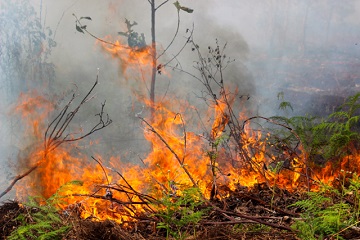
Forests were the lungs of the world because the forest played an important role in the human life both as a primary source of oxygen producers, regulating the balance of ecosystems and habitats for many living things. In the event of a forest fire of course it brought adverse effects for the humans, the ecosystems and the environment. The impacts of the forest fires included the loss of habitat for living things, the damaged ecosystem environment, the reduced supply of oxygen in nature, the contaminated air, the disruption of the aircraft navigation system, and causing the global warming due to the release of CO2 substances into the atmosphere of combustion.
Researchers from Bogor Agricultural University (IPB) conducted the research related on the sequential pattern mining on the hotspot data as an indicator of the forest fires and the peatlands in Kalimantan. They were Lailan Syaufina (Department of Silviculture, Faculty of Forestry), Imas Sukaesih Sitanggang, Rina Trismingsih, Husnul Khotimah (Department of Computer Science, FMIPA) of IPB.
Imas said that, the hotspot was one indicator of the forest and land fire incidents in Indonesia. Not all hotspots were strong indicators of the forest and land fires. The incidence of hotspot successfully at least in 3 days at a location could be a strong indicator of the forest and land fires, especially on the peatlands. Spatio-temporal data mining approach could be used to the get the pattern of the hotspots sequence meant.
“This research manages to get the pattern of the sequence of the hotspot appearance in the peatland in Kalimantan island using the sequential pattern mining approach by applying the algorithm of SPADE (Sequential Pattern Discovery using Equivalence classes),” she said.
The sequence pattern of hotspot generated at a minimum support value of 0.1% that was 175 sequences in Kalimantan in 2014 and 295 sequences in Kalimantan in 2015. The hotspot sequences were combined with the weather data to obtain the association pattern between the emergence of the hotspot sequences with the weather data by the association rule mining approach.
The sequence pattern of the hotspot appeared in Kalimantan in 2014 occured in weather conditions with the average humidity of between 77.7–82.5%, the average temperature between 27.00–27.69°C, and the rainfall 0. While in 2015, the pattern occurred in the weather condition with the average humidity between 65.8–72.1% and 78.6–84.9%, the average temperature between 27.38–29.32°C, and the rainfall between 0.0–0.9 mm.
“The result of this research has significance in the prevention of the peatland fires to minimize the occurrence of the fires and their effects in the future,” she said.(AT/Zul)