A Group of Researchers of IPB Studied the Habitat of Sikep Honey Asia and Javan Hawk for Conservation
Bird of prey or predatory bird, also known as raptors, refers to several species of birds that hunt and feed on rodents and other small animals. Every birder can recognize raptors, but there are subtle distinctions between different types of birds of prey that make each one unique. From size to wing shape to feeding habits, raptors are diverse and understanding the differences between the different types can help birders more quickly identify the birds of prey they see. Hawks, eagles, vultures, kites, ospreys, falcons, and owls are all among the birds sometimes considered raptors, or birds of prey, raptor coming from the Latin verb rapere, to grab, to seize, to carry away. The Sikep Madu-Asia (crested honey buzzard Pernis ptilorhynchus) is a bird of prey in the family Accipitridae, which also includes many other diurnal raptors such as kites, eagles, and harriers. Another birds of prey available in Indonesia is the Java Eagle (Nisaetus bartelsi), an Indonesian endemic, the Javan hawk-eagle occurs in humid tropical forests of Java. Birds of prey (raptor) have a very important role in an ecosystem. According to the habits of life raptor is divided into two that is the migration and the settled or non-migration.
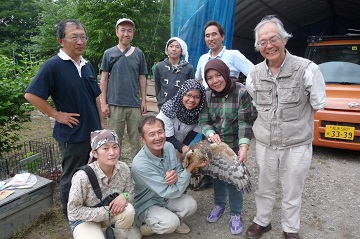
Syartinilia Wijaya and Afra DN Makalew of the Department of Landscape Architecture of the Faculty of Agriculture of Bogor Agricultural Institute (FAPERTA IPB) and Yeni A Mulyani of the Department of Forest Resources Conservation and Ecotourism, of the Faculty of Forestry (FAHUTAN IPB) implemented the research program on the habitat of crested honey buzzard and Javanese eagle in supporting the preservation of species priority and environmental indicators.
"Raptor or predator in the food chain is at the top of the food chain that acts as a top predator. Eagle can help to control agricultural pests, such as snakes, rats, squirrels and other types of insects, including grasshoppers. In one stop location, eagle groups will stay for two days. After that, they will continue their trips to the different locations. The population should not be much, but it should not be nonexistent, as it is the ecosystem's controller. So if in an ecosystem there are animals we can quickly assess the quality of the environment. In addition, raptors are also a key species in which many other species depend on the presence of the species, "explained Syartinilia.
Honey-Asia Sikep migrates in a great distance from its breeding habitat in Japan to winter habitat in Southeast Asia. This species has an extremely large range, and hence does not approach the thresholds for Vulnerable under the range size criterion. The Oriental honey-buzzard feeds predominately on the combs, larvae, pupae and adults of social bees, wasps and hornets, but will also take other insects, reptiles, frogs, small mammals, and young or injured birds. It is normally a solitary and secretive bird, but sometimes aggregates in small flocks when migrating or moving locally in response to food supplies. Raptors who migrate their lives depend on three habitats. Origin habitat or habitat called breeding is in Japan, then habitat settled in Indonesia that is called wintering habitat, and stop over habitat is habitat stop during the migration trip. To observe the distribution and the migration of Sikep Madu-Asia, the use of satellite tracking technology is an excellent option for providing information on routes, periods and locations of winter habitats and transit habitats during migration. Since 2003 have been recorded traces of 59 individuals Sikep Honey Asia using satellite-tracking technology (ARGOS).
"So why does Sikep Madu-Asia migrate to Indonesia? The main reason is to find food where the main food is bee larvae / wasps. Raptors are at the top of the food chain, so their healths depend on the health of the whole ecosystem they live in. Declines in their populations can indicate a problem in the specific ecosystem that raptor species depend upon or visit. As we know that in the tropical country it bees all the time. If in Japan it's not, it's only in the summer, "he said.
Yet, Java Eagle is one of the 25 priority species set by the Director General of PHKA to be increased by 10 percent by 2015-2019 (SK Dirjen PHKA No. 200 / IV / KKH / 2015). Unfortunately, serious environmental degradation such as habitat loss, forest fragmentation, and illegal hunting or trafficking have threatened the safety of the Java Eagles.
" There are so many endemic species that can be found in Indonesia. Endemic species is animals or plants that only can be found in one specific region. Javan Hawk Eagle is one of the species of eagle that live in Indonesia. One of the animals that became endemic species in Indonesia is Javan Hawk Eagle (Nisaetus bartelsi). This Java eagle is endemic, its life is only on the island of Java. This Eagle is an indicator of environmental quality in Java. Specifically, the Javanese eagle lives is dependent on the existence of natural forests for breeding. So the Java Eagle is also an indicator of the exist ence of natural forests on the island of Java, "he said.
Faculty member of the Department of Landscape Architecture Lecturer of the Faculty of Agriculture of IPB obtained his doctoral degree from The University of Tokyo in 2008 with his dissertation topic on modeling the distribution of Java-based Geographical Information System (GIS) habitat. This research used multiscale approach in Java Island. His Javanese eagle research was the continuation of his research while taking a doctoral degree program. While research on Sikep Honey-Asia has started since 2010 through cooperation with Prof. Hiroyoshi Higuchi who was one of his supervisors for his dissertation.
The study aims to update the distribution data of Java Eagle habitat as well as its habitat connectivity in Java Island as well as its characteristics of winter habitat landscape, as well as Sicep Honey Asian habitat in Indonesia. The results of the study are the basis for the preparation of the management plan / preservation of both species based on landscape ecology.
The research team found that Java Eagle habitat in West Java, Central Java, and East Java has increased since 2002. This is due to the recovery of some previously destroyed habitats. In addition, several patches of Java Eagle habitat are isolated from other patches. Distribution of Javan Hawk Eagle is only limited in Java Island, from the west tip of this island (Ujung Kulon National Park) to the east tip of this island (Blambangan Purwo Peninsula). So this information becomes important for the planning of connectivity between patches to maintain the sustainability of the eagle of Java in the future. The habitat of this type of bird is usually quite hard to be reached even though sometimes the habitat of this bird is not always too far from location of human activities. It seems that this type of bird is very depending on the presence of primary forest as its habitat. While at Sikep Madu-Asia found that the availability of food and thermal winds became the main requirement in the choice of habitat in both wintering habitat and stop over habitat, only the quality that distinguishes it. It breeds in Asia from central Siberia east to Japan. It is a summer migrant to Siberia, wintering in tropical Southeast Asia. Elsewhere, it is more-or-less resident. It is a specialist feeder, living mainly on the larvae of social bees and wasps, and eating bits of comb and honey; it takes other small insect prey such as cicadas. Sikep Honey-Asia can stay up to 40 days in wintering habitat.
The research was funded by Kemenristekdikti and the Japanese Ministry of Environment for satellite-tracking data of Sikep Madu-Asia. The results of this study have been published in various international and national journals and presented in various symposium forums both in Indonesia and abroad.(Wied)