
Toward Idul adha, FKH IPB Sends Its Staff and Students to be Animal Health Inspectors and Meat Sacrifice to Assist the Communities
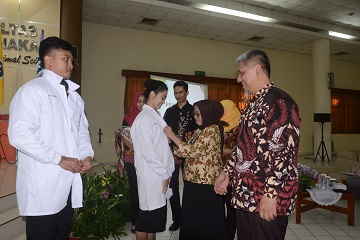
The Dean of the Faculty of Veterinary Medicine of Bogor Agricultural University (FKH IPB), Prof. Dr. Drh. Srihadi Agung Priyono, despatched 715 students and 55 faculty members of FKH IPB as animal health inspector and sacrifice meat. The despatching event took place at Auditorium Jannes Humuntal Hutasoit of the Faculty of Animal Husbandry (FAPET), IPB Campus, Dramaga, Bogor, on 25 August 2017.
Prof. Srihadi said the physical examination of animal health. According to the government regulations, the criteria for animal sacrifice they have to be Safe, Healthy, Intact, and Halal (ASUH). He said this activity provides great benefits for people, as they have to be more careful in slaughtering animals sacrifice.
"Veterinary profession is very important and needed in the community, this activity is intended to emphasize the importance of dedication to the community a community service," he said.
He explained, the first thing to consider critically in the animal sacrifices they have to meet the prescribed method of ritual slaughter of all lawful halal animals. The slaughter of animals must not occur in front of other animals. Animals that are sacrificed are large cattle and healthy. In Indonesia, the animal you select for sacrifice must be a one-year-old male, either a sheep or a goat, or buffalo. Another requirement the acceptable age for an animal they must be sufficient age (above one year). Furthermore, other criteria to be met for the sacrifice animals, they have to be raised in natural conditions, eating natural foods and be respected. All of these conditions of permissibility emphasize the seriousness of animal life.
He explained that besides the sacrifice animals must be healthy animals, meat sacrifice is also required as a healthy meat. Besides that healthy meat to be distributed to the general public, the sacrificial meats should be distributed in the exact way as the committee set, or to be mixed up with other ingredients. Do not let the meat of the sacrifice mixed with the sand / soil as meats are cut into on the ground without pedestal. Furthermore, because meat is a perishable food, immediately after being cut the meats must be packed properly might be using white plastic to avoid being contaminated by germs due to hand touches. After the packing should be sacrificed meats immediately distributed to be cooked or to be preserved.
Chairman of the Organizing Committee, drh. Ardilasunu Wicaksono, M. Si, explained that the importance of sacrifice animals health inspection can improve the public awareness in handling sacrifice animals well, especially according to Islamic Shari'a. The animal sacrifice is a demonstration of total submission to Allah and a proof of complete obedience to Allah's will or command, thus, they have to be the best. "Inspection of livestock is also to be aware of animal zoonotic diseases known as infectious agents," he said.
The animal health inspectors and sacrifice meat will be sent to 5 (five) districts / cities, namely Bogor Regency 100 (hundred) students, Bogor City 180 (hundred eighty) students, Jakarta Capital City and Kepulauan Seribu 300 (three hundred) students, Depok City 85 (eighty five) students, and Bekasi City 50 (fifty) students.
Also present on this special occasion are the Head of Fishery and Animal Husbandry Services of Bogor Regency, Ir. Siti Farikah, MM. She expressed her sincere welcome for this special event and she expected that this cooperation would be improved so the community at large understand the first thing to consider critically in the animal sacrifices they have to meet the prescribed method of ritual slaughter of all lawful halal animals, and they meet the criteria to be Safe, Healthy, Intact, and Halal (ASUH).
This activity is a collaborative work between FKH IPB with Institute of Research and Community Service (LPPM) of IPB, and Directorate of Cooperation and International Program of IPB. The program is also supported by Department of Agriculture and Fishery of Bekasi City; Agriculture Services of Bogor City; Department of Food Security, Maritime and Agriculture of DKI Jakarta Province; Depok Food and Fisheries Food Security Office; as well as Fisheries and Animal Husbandry Department Services of Bogor Regency. (Wied)

