Academicians of IPB Proposed that the Agriculture Ministry Will Evaluate BPP and HET of Premium Rice
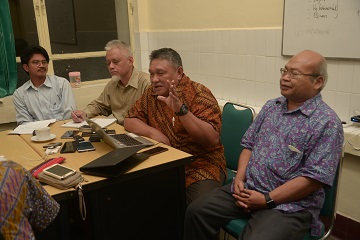
Academicians of the Department of Agronomy and Horticulture (AGH), Faculty of Agriculture of Bogor Agricultural University (FAPERTA IPB) organized a meeting to discuss the chaos of premium rice. The academicians were Prof. Dr. Sudarsono, Dr. Sugiyanta, Dr. Purwono, Dr. Iskandar Lubis, Dr. Winarso D. Widodo, Dr. Asep Setiawan, Dr. Willy Bayuardi Suwarno, Dr. Deden D. Matra, Dr. Ahmad Junaedi and Hafith Furqono, SP, M.Sc. The recommendations of the meeting were presented directly in 'AGH Meet the Press', on Tuesday evening, 25 July 2017, at IPB Campus, Baranangsiang, Bogor.
"The first point of discussion was to propose to the government the clarification of bogus premium rice chaos. The second point of our meeting was to request the government to clarify the rice nomenclature, "said Drs. Sugiyanta who is also Chairman of AGH Department of FAPERTA IPB.
The conclusions of the discussion of academicians of Department of AGH of FAPERTA IPB, moderated by Professor Chair Holder of the Faculty of Agriculture of IPB, Prof. Sudarsono, are as follows:
1.Clarification of the most commonly planted rice varieties grown by farmers in Indonesia. Farmers used to mention all type of rice to be cere rice (Indica rice without Ryu's hairs) derived from IR 64 (Ciherang, Mekongga, and others) varieties with IR rice. Whereas IR 64 varieties have been minimally planted by farmers. In the past, IR 64 was the most popular cultivars varieties grown by farmers. But, as time goes on there are Crop Variety Improvement programs. They produced IR 64 derivatives with an added value such as Inpari.
2.There is no pengoplosan (mixture) terminology for rice, but there is only rice mix. In the practice of rice business, there are rarely traders who sell 100 per cent pure rice derived from one variety. Commonly traders in the rice business sell the mixed rice made up of a number of rice varieties with a certain composition or mixing rice originating from various harvest locations. The activity of mixing rice as long as it meets the grade requirements for the classes of rough rice (that meet on the desired Indonesian National Standard or SNI) does not violate the provisions of SNI. In the SNI there is no prohibition of mixing rice from various varieties and then selling it, as long as it meets the SNI requirement.
3.The quality of milled rice based on the standard process of SNI divide rice in general into medium and premium rice. Mixed rice made of various varieties as long as it meets all the criteria of SNI as premium rice will be classified as premium rice. Conversely, if only meet criteria of SNI medium rice will be classified as medium rice.
4.The medium mixed rice is processed as to meet the SNI criteria of premium rice is also classified as medium grain premium rice. Rice mixed then packed and labeled pandan wangi (trademark is not pandan wangi varieties) is legitimate only. In SNI rules there is no necessity of premium rice should be aromatic or have a certain taste, prohibition by government is by adding harmful chemicals for bleaching rice, it will violate the SNI.
5.The difference between medium and premium rice. If traders mix the rice and the result is in accordance with SNI no. 6128, then the blend of rice can be referred to as premium rice. Moisture Content of grain of premium rice should be less than 14 percent, the milling degree must be 100 percent, whole grains of rice above 75 percent, head rice yield at least 95 percent, with 60 percent intact rice, mixture of brown rice should not be more than 5 percent, and no other colours or broken rice.
6.The Agriculture Ministry data show the sale of premium rice is only 2.5 percent of the total trade of rice at a record 40 million tons per year. The country's turnover of rice trade for a year is 40 million tonnes multiplied by Rp 10 thousand (the average selling price of rice), amounted to Rp 400 trillion. So the total number of this Rp. 400 Trillion is the total of national rice trade turnover per year. If premium rice takes 2.5 percent of the total turnover of only Rp 10 trillion per year.
Pricing of Rice in Indonesia
7.The new (the Highest Retail Price (HET) of rice according to the Ministry of Trade Regulation (Permendag) 2017 that rice was a uniform product with a single price. Determination of this HET is to protect consumers and provide assurance to producers to get a decent profit.
8.The question arises whether the basic calculation of the HET (Price Ceilings) is established by the government. Price Ceilings are maximum prices set by the government for particular goods and services that they believe are being sold at too high of a price and thus consumers need some help purchasing them. Price ceilings only become a problem when they are set below the market equilibrium price. For rice business it is expected the HET will already beneficial all the rice industry players. The count for the determination of HET is the Cost of Production (BPP) per kilogram plus the profits of farmers into harga pembelian pemerintah (HPP The government purchase price). HPP. HPP plus trading margins to HET for bulk rice (medium rice). The difference between HPP and BPP is the profit margin of farmers and between HET and HPP is the profit margin of the rice businessman. Determination of BPP is the realm of Kementan, HPP is the realm of Kemenko and HET is the domain of the Ministry of Trade.
9.Cost of Production (BPP) should be calculated as real cost production, which can be determined in the form of average cost in reasonable and favorable conditions. An overpowering BPP determination can cause farmers' profit margins to fall if the HPP is fixed. Conversely, a BPP that is too low in addition does not reflect the real conditions in the field, will artificially boost the profits of farmers. Therefore BPP should be periodically evaluated to reflect reasonable costs.
10.To get premium rice, there is a processing fee to achieve SNI standard, so the HET premium rice must be different with HET medium rice. For example, there is one quintal of dried milled grain, it weight will shrinkage due to the milling process of grain into rice. To get premium quality, the rice is processed again, they are milled several times up to 100 percent milled, and packed attractively. In addition, premium rice is usually sold in supermarkets so there are tax, consignment and transportation fees. Thus the difference in the price of rice in supermarkets with medium HET rice (the selling price of supermarkets minus HET) can not be used as a profit calculation number. That is, the additional charge above the HET to get premium rice. Therefore HET premium rice should be higher than medium rice.
In relation to the proposal to the government, the academician of the Department of Agronomy and Horticulture (AGH), Faculty of Agriculture of Bogor Agricultural University (FAPERTA IPB) will propose, as follow: 1. First, set different HET for bulk rice (medium quality) and premium rice; and Second. The government (the Agriculture Ministry) to periodically evaluate BPP. Since the BPP calculation figures used by the Agriculture Ministry must be adjusted to the current field conditions. For example, land rent and labour costs. (Wied)