
Student of IPB Researched Genes to Improve the Quality of Free-Range Chicken Meat
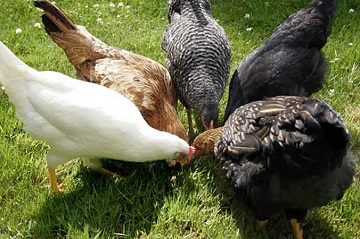
Free-range chicken was the chicken native to Indonesia which still had the relatively low productivity compared to purebred chicken. The free-range chicken had the advantage at the adaptation level, the resistance to heat, and the high diseases resistance. The free-range chicken also had the delicious taste and the distinctive aroma which were related to the fat content in meat. However, the low productivity of the free-range chicken was inversely related to the demand for the free-range chicken meat consumption in the community. Therefore, it was necessary to increase the productivity of the free-range chicken through the selection.
The production of the free-range chicken meat only accounted for 15.13 percent from the total production of the poultry meat and 10.26 percent from the total production of the livestock meat in Indonesia. Therefore, the free-range chicken had the potential to be improved as the fulfilment of the food security program that was safe, healthy, whole and halal (ASUH). One effort which could be made to improve the quality and quality of the free-range chicken was through the genetic marker-based selection (the nature of growth and quality of meat).
Two genes that controlled i.e. the genes of IGF2 (Insuline-like Growth Factor 2) and FMO3 (Flavincontaining monooxygenases 3) as the growth control gene and the carcass quality could be used as the potential genes in the genetic marker based selection to improve the free-range chicken productivity.
Student of Department of Animal Science Production and Technology, Faculty of Animal Husbandry (Fapet), Bogor Agricultural University (IPB), Rindang Laras Suhita, did a research entitled “Keragaman Gen IGF2 dan FMO3 serta Asosiasinya terhadap Bobot Potong dan Sifat Fisik Daging pada Ayam Kampung / The Diversity of IGF2 and FMO3 Genes and their Association with the Cutting Weight and the Physical Property of Meat at the Free-Range Chicken”. This research was guided by Dr. agr Asep Gunawan, Prof.Dr. Cece Sumatri, and Dr. Niken Ulupi.
The research consisted of two stages i.e. the diversity analysis of the genes of IGF2 and FMO3 in the two populations of the free-range chicken and some local chicken as the comparison. The samples used were as much as 118 samples of the free-range chicken for the IGF2 gene consisting of the population of the free-range chicken of 12 weeks, and the population of the free-range chicken of 26 weeks. As much as 129 samples of the blood of the free-range chicken used for the FMO3 gene consisted of 6 populations, namely broiler, free-range, sentul, merawang, pelung, and nunukan.
The free-range chicken used for the association was as many as 118 chicken for the carcass weight and the commercial cuts, as well as 56 chicken for the physical properties of the carcass. Genotyping was done by using the method of PCR-RFLP (Polymerase Chain Reaction-Restriction Fragment Length Polymorphism). The data analysis performed were the genotype frequency, the allele frequency, the heterozygosity, the balance of Hardy-Weinberg, and the association of the genotype data with the phenotype using General Linear Model (GLM).
The results showed that the IGF2 gene in the two populations of the free-range chicken was polymorphic and the FMO3 gene in all populations was monomorphic. The IGF2 gene in the population of the free-range chicken of 12 weeks had a low diversity, and in the population of 26 weeks it had a high diversity, whereas in the FMO3 gene it was not found of the diversity. It was found the association suggestively of IGF2 gene with the weight of the lower thigh in the free-range chicken of 26 weeks. No associations were found between the diversity of IGF2 and FMO3 genes against the cut weights and the physical properties of the carcasses in the free-range chicken.(AT/NM)

