
A Group of IPB Students Utilized Dragon Fruit Skin For Tomatoes Coating
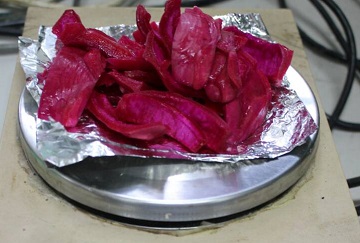
If you love fruits, you would want to try out the exotic variety out there. What is this fruit? Dragon fruit is a tropical fruit that has become increasingly popular in recent years. Fruit that can now be found almost in all fruit shops and juice vendors on the streets. The two most common types have bright, red skin with green scales that resemble a dragon. Dragon fruit may look exotic, but its flavours are similar to other fruits. Its taste has been described as a slightly sweet cross between a kiwi and a pear. The shape of an eccentric fruit comes with the colour of the exotic fruit flesh and not forget also with the taste that is so refreshing almost no one can resist the fruit that has a bright red color. Who would have thought that the skin of this dragon fruit can be used as a coating for tomatoes.
A group of students who come the same Department of Faculty of Agriculture of Bogor Agricultural University (FAPERTA IPB), under the sponsorships of 2017 Program Kreativitas Mahasiswa (PKM-E Student Creativity Program for Entrepreneurship) designed the research program on the utilization of dragon fruit as Dragon Coat (dragon fruit coating) on tomatoes.
The tomato is the edible fruit of Solanum lycopersicum, commonly known as a tomato plant, which belongs to the nightshade family, Solanaceae. Tomato (Lycopersicon esculentum Mill.). The tomato is now grown and eaten around the world, including Indonesia. It is used in diverse ways, including raw in salads, juice, sambal and processed into ketchup or tomato soup. Unripe green tomatoes can also be breaded and fried, used to make salsa, or pickled. Tomato plants are widely cultivated in Indonesia because it can grow from sea level up to about 1250 m altitude at the equator. According to Statistics Indonesia (2013) the tomatoes production of increased by 5.18% from 2008 to 2009, but the decline around 6.96% in 2012. A number of tomato troubles (insect, disease, environmental) can wreak havoc on our favourite plants. Fusarium wilt, caused by Fusarium oxysporum f. sp. lycopersici (Sacc.) W.C. Snyder and H.N. Hans, is considered as one of the most important disease of tomato worldwide.
Tomato Fusarium wilt is considered as one of the most important diseases of tomato both in field and greenhouse-grown tomatoes worldwide. The disease caused by this fungus is characterized by wilted plants, yellowed leaves and minimal/reduced or even total loss/absent crop yield. The Fusarium fungus is a known pathogen of tomato plant which is present in all important tomato growing regions of the world. Some strains of Fusarium oxysporum are not pathogenic and may even antagonize the growth of pathogenic strains and can be used as biological agents. The control of Fusarium wilt of tomato is important in maintaining plant vigour and fruit quality and quantity. Various efforts in the control of this fungus one of them is a chemical fungicide, but the fungicide can harm health and pollute the environment. Documented methods that are used in the control of the disease include cultural, biological, use of resistance, chemical and use of natural products.
Research was carried out in the Plant Mycology Laboratory, Department of Plant Protection, Faculty of Agriculture of IPB utilize dragon fruit skin, it was then extracted using sterilized water. Then extract was tested against Fusarium sp, oth in vitro (laboratory scale) and in vivo (large scale). The coating will be processed using mixture of dragon fruit skin extracts with starch, so the tomatoes are accidentally consumed it won’t harm.
The group which is consisted of Yulianto, Ayu Leana Dewi, Ade Fitri Nurdika, and Noni Irnadianis Wibiani expected that the results their research program will utilize dragon fruit skin waste which are generally untapped to be added-value products. In addition, the group also expected that research program was only preliminary one that might be expanded into further processes. Finally, they hope that results of their study will be disseminated to be the alternative effective and environmentally friendly control agent for postharvest disease caused by fungus. (Wied)

