A Group of IPB Students Created an Instrument to Analysis the Population Density of Phytoplankton Accurately and Rapidly
Science continues to grow as technology advances and human needs increase. Technology and human life cannot be separated; society has a cyclical co-dependence on technology. It is impossible to explore how each new advanced technology has impacted our lives and how it will impact the future. For many of us, accepting new technologies and replacing the old is a challenge. However, choosing to ignore new and updated technologies may adversely affect our wellbeing. The speed and accuracy of field data retrieval is now no longer possible. Both properties of the data are increasingly important and needed by different areas of life.
Marine and fisheries science explains that phytoplankton are important to the global ecosystem as they are responsible for half of the photosynthetic activity on the planet. They are producers, or autotrophs, that form the foundation of most marine food webs. As tiny photosynthetic organisms, they are the major producers of marine life, they are a key food item in both aquaculture and mariculture. In mariculture, the phytoplankton is naturally occurring and is introduced into enclosures with the normal circulation of seawater. The availability of phytoplankton become important data for aquaculture activity, in determining the fisheries areas, as well as scientific data to other academic purposes. Up to now method to calculate the population density of phytoplankton is using inverted microscope (conventionally) to enumerate the cell density. This conventionally method is really time consuming, and also requires special personnel for observation. Temporal patterns of species abundance, although less well-studied than spatial patterns, provide valuable insight to the processes governing community assembly. Thus dynamic and more careful analysis of the population density of phytoplankton is really required.
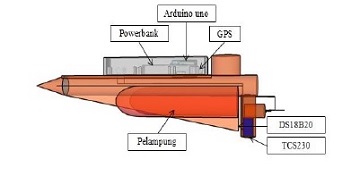
To provide dynamic and more careful analysis on the population density of phytoplankton, a group of students of Faculty of Fishery and Marine Science – FPIK for Program Kreativitas Mahasiswa bidang Penelitian (PKM-P Student Creativity Program for Research) consisted of Aditya Permana Sidiq, Azhar Slamet, Jordan Tito Lubis, and Geza Saputra created an instrument to conduct a vital phytoplankton levels quickly and easily, they called it “Mr. Phyton”. Applying the principle of absorption and fluorescence, light sensors and heat sensors are used in this tool to measure the level of density of phytoplankton in surface water and surface temperature.
The digitization as a technical process to capture different color images of a water surface to mark differences in the phytoplankton composition in large-scale waters. This simple phytoplankton calculating tool is applicable for marine waters and rivers as well. "It is an easy-operated instrument, just attach it in a small model aircraft flown that is being by pulling from the boat" said Aditya Permana Shiddiq as the team leader.
“Mr. Phyton” is also equipped with the GPS surface mapping. Spatial data has coordinate systems to perform spatially accurate analysis, and to make maps. In addition, th movement will automatically navigable referring to the desired ordinate.
Components used for “Mr. Phyton”. Are as follows, TCS230 RGB Sensor to extract cell composition data from phytoplankton on surface waters; DS18B20 to measure water temperature. Then it is equipped by the real time clock to record time and date of the retrieved data. The data obtained will be stored on the memory card. This instrument is supported by the portable power provider. All components mounted on Mr. Phyton but the incoming data will be sent directly to the communication device held by the operator in a separate place.
The PKM-P group have been trying to complete “Mr. Phyton” since March 2017. They planned to test “Mr. Phyton” in Pelabuan Ratu, and Banten. The group expected the equipment they created will be an important tool to monitor the condition of marine waters and rivers, to get the population data of phytoplankton on them. Finally, the group also expected that academicians and fisheries managers will utilize their creation. (Wied)