Professor of IPB: If Seawater rises by One Meter, Farmland of 120 Hectares will get lost.
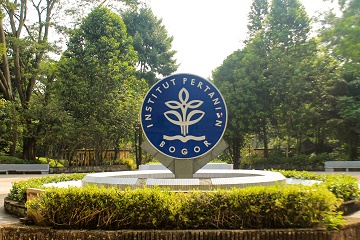
In commemoration of the world Food Day, celebrated every October 16, three professors of Bogor Agricultural University (IPB) contribute ideas in a joint press conference held at Baranangsiang Campus of IPB, Bogor, Sunday (16/10). One professor delivering his idea is Prof.Dr. Rizaldi Boer.
The frequency and intensity of extreme climate occurrence will increase and so it is predicted that crop harvest failures will occur more frequently. The frequency of massive droughts before 1960s was only once in 4-5 years and after 1960s once in three years. The rice crop failures due to drought could reach more than 300 thousand hectares.
"Another problem is the loss of agricultural land in coastal areas due to the rising sea level and salinity. One meter rise of sea level is expected to submerge approximately 120.446 hectares of agricultural land. This phenomenon has occurred in Bengkalis, the northern coast and other regions. Farmers in such areas have already converted their fields into salt mining and fish ponds because it is difficult to obtain a high yield of rice," he said.
The effect of rising global temperatures due to climate change also lowers crop productivity, not to mention the problem of land conversion. Assuming the converted land use of 30 thousand hectares per year, then the ability of Java to produce in 2025 will drop by about five million tons compared to the current production level and about 10 million tons by 2050.
"This loss does not include yield losses due to extreme climate and the impact of rising sea level," he explained.
So to achieve the food crop system that is resilient to climate, various efforts (structural or non-structural) are required. Adoption of smart climatic technologies for high yield by farmers needs to be accelerated.
"One of the strategies initiated by IPB is an insurance system called 'climate index insurance' in collaboration with several parties. With this insurance, farmers have the courage to try the technology because if the crop is to fail due to climate disaster, they get a payment from the insurer. And if the climate is in good condition, their harvest obtained will be higher as a result of better farming technologies," he said.
Climate index insurance is an insurance system in which the insurance claim payments are based on climate indices instead of crop failure. However, the climate index is determined based on the relationship of crop failure to the climatic conditions. If, historically, the plants usually fail to harvest during the growing season with the rain fall of less than 150 mm, then the value of 150 mm is used as the climate index. This means that when the rainfall during the growing season is less than 150 mm, the farmer participating in the index insurance will automatically get payment, regardless of whether not the plants die. If the new cultivation techniques applied is resistant to drought, or plant still survive although rainfall is less than 150 mm, the participant farmers will still receive payment. They will also get the income from the plant because it can survive. In conventional insurance, there will no payment if the plants can survive.
This program is expected to encourage farmers to try new technologies of higher yields to take advantage of the year with good climatic conditions and if the climate is not favorable, farmers still earn revenue from the climate insurance. Additional profits in good years as a result of better farming technologies could exceed the premium value. The constraints for farmers to try a new technology are limited funding and lack of technology control.
Therefore, an effective implementation of the climate index insurance program should be integrated with the support programs of microfinance and technology along with assistance. IPB with the central Asia insurance (ACA) and the Syngenta Foundation and several micro funding agencies and agricultural extension agencies is conducting a pilot development of climate index insurance in Indramayu, namely in Tukdana and Tract for rice. The program is expected to be one of the new breakthroughs to increase farmers' resilience to the rising climate risks. *** (Mtd)