
IPB Delegates Take Part in the United Nations Model in Geneva
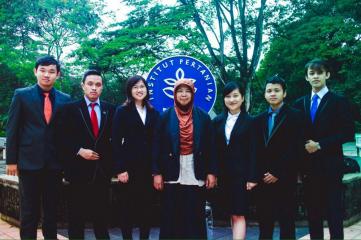
Delegates of Bogor Agricultural University (IPB) flew to Geneva for diplomacy at the world level competition of simulated session of the United Nations, Wednesday (3/3). As in previous years, this year IPB sent its delegation to participate in the Geneva International Model of United Nations (GIMUN) 2016, held at the United Nations Office in Geneva (UNOG), Switzerland.
GIMUN is an annual competition of simulated UN General Assembly held in cooperation between the University of Geneva and the Graduate Institute for International and Development Studies in Geneva, Switzerland. 250 participants selected from more than 50 countries will compete in the five-day conference sessions to discuss various global issues. In addition, GIMUN also held a variety of social activities in order to improve the experience of participants in cross-cultural interaction and socialization.
IPB delegates consist of six S1students, namely Denny Aprilio Pratama (Department of Computer Science, Faculty of Mathematics and Natural Sciences), Charlie Sanjaya (Department of Agribusiness, Faculty of Economics and Management), Olivia Mellyana Tjiptoputri (Department of Food Science and Technology, Faculty of Agricultural Technology), Chiara Nadya Tanudjaja (Department of Industrial Technology, Faculty of Agricultural Technology), Dairul Fuhron (Department of Statistics, Faculty of Mathematics and Natural Sciences), and Muhammad Murtadha Ramadan (Department of Computer Science, Faculty of Mathematics and Natural Sciences). These six students are members of The Student Activity Unit (UKM) of IPB for Debating Community (IDC), which is the place for IPB students to learn and practice of the UN Model.
IPB delegation will be representatives for Germany, Argentina, France, Republic of Marsal Island, and the Democratic Republic of Congo. They are distributed to four committees, namely the United Nations Security Council (UNSC), the World Health Organization (WHO), the Human Rights Council (HRC), and the Disarmament and International Security (DISEC). The four Committee will discuss various important issues of the world from the threat of cyber war, terrorism, the importance of the rights of former criminals, to an improved quality of health care services.
The simulated UN General Assembly begins by determining the agenda of topics to be discussed in accordance with their respective committees. Then, each delegate has the opportunity to express opinions in accordance with the views and interests of the state represented. Each delegate will exchange ideas with each other through a debate, lobbying and negotiation. Each session is expected to produce a draft resolution that is effective to address the issue in question as well as the best interests of all countries.
"In addition to the English language skills, Model UN is an excellent medium to train communication skills and critical thinking. Each delegate is required to negotiate and collaborate with other delegations to resolve problems. In addition, each delegate is also required to think quickly and critically in the debate over global issues that occur during the meeting," says Head of Delegation, Denny Aprilio Pratama. *** (Mtd)

