Animal Welfare Puzzle Teaches Empathy to Kids in Early Childhood Wednesday, June 10, 2015
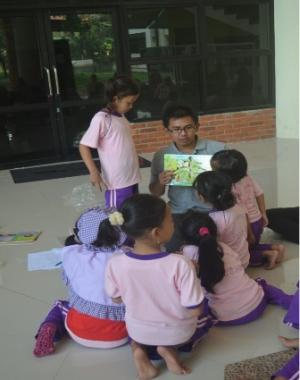
Anwelf Puzzle or Animal Welfare Puzzle is one of the activities by the Student Creativity Program (PKM) for Community Services organized by the students of the Faculty of Veterinary Medicine (FKH), Bogor Agricultural University (IPB). This PKM, chaired by Faizal Rafiq with four members, namely Maria Paramita Intan, Dedi Nur Aripin, Chairani Rida M, and Shaugi Chasbullah, is under the supervision of DVM. Andriyanto M.Sc.
Anwelf Puzzle collaborate with the Early Childhood Education (ECD) “Cahaya Kita” in Sukadamai village, Cilubang Kampoang, Dramaga District of Bogor Regency. The program is to develop an educational game model for early childhood in the form of a puzzle in the theme of animal welfare. The purpose is to teach children of early childhood empathy for others through the values of animal welfare.
"A good teaching method for children of early age is appropriately carried out with affective approach, one of which is through games that develop their mental equilibrium and motoric skills because this period is the golden age or the peak of their creativity development," said DVM. Andriyanto, M. Si.
This program has been running since February to May. One of these programs was a post-test and playing the Anwelf Puzzle together in FKH-IPB on Friday, May 22, 2015. Pupils of the Early Childhood Education “Cahaya Kita” played the Anwelf Puzzle together and then observed and interacted directly with the animals available at FKH-IPB. Their attitudes and behaviors improved in terms of interacting with the animals, they became more concerned about the animals around. The hope is that this behavior developing from the learning media of the Anwelf Puzzle can also be applied to other fellows.
DVM. Andriyanto as a mentor and the PKM team of Anwelf Puzzle hope this model of instructional media can continue and become one of the compulsory subjects, not only in the Early Childhood Education “Chaya Kita but also in other schools. (Mtd)