Agriculture Deterioration Has Started Since 1999
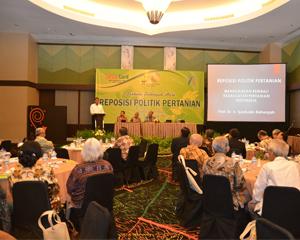
In order to get financial aid, Indonesia was forced to fulfill the terms and conditions of IGGI and IMF towards a liberal economy. Since then there’s been no longer the nation’s agricultural policy, no Indonesian agricultural sovereignty.
"There we see that we are deprived of our freedom, forced to import and accept the entry of foreign investors, and we cannot prevent retail products of commerce," said Prof. Dr. Ir. Sjarifudin Baharsjah in the seminar “Repositioning Politics in Agriculture at IICC (17/9).
The reform in 1999 was not able to stem the impact of IGGI and IMF intervention, but on the contrary the agricultural sector has been deteriorating, which is worse than Agricultural Involution of Geertz.
Moreover, the main cause of agricultural deterioration at the moment is the lack of agreement on long-term goals of agricultural development. Policy makers tend to make short-term decisions without concern for the long-term targets. If any, the targets are usually formulated in terms of self-sufficiencies (in rice, corn, sugar, soybeans), which have unfortunately never been achieved.
"In order to achieve self-sufficiency, but it takes a lot of efforts, but many get confused. For example, farmers are confused about achieving the self-sufficiency: where is the land? “He explained.
"The agricultural economy is marked by an imbalance of benefits derived from the work of farmers in rural areas compared to those received by workers in industry and services," said the former Minister of Agriculture in Development Cabinet VII accompanied by two Deputies of Ministers of the United Indonesia Cabinet, Deputy Minister of Agriculture and Deputy Minister of Trade .
The wage gap is widening, farmers are the greatest in number of all workers nationally. Of particular concern is an increasing poverty. To avoid this, it is necessary to reposition the agricultural policy that emphasizes its position and role in the development of the nation.
In his view, the first step towards political repositioning of agriculture is to restore the independence of farmers, invite entrepreneurs to become stakeholders instead of being only profit hunters, ensure farmers’ access to land and water resources, improve the quality of human resources, eliminate market distortions and improve agricultural statistics.
Put Agriculture Graduates in All Sectors
Meanwhile, according to Deputy Minister of Trade Bayu Krisnamurti in discussing the political Repositioning of Agriculture, it is no longer the time to make agriculture versus industry and services sectors. What is right is agriculture and industry and services.
"There won’t be any success if the paradigm is still agriculture versus industry, services and trade. The dynamics has become such away; if there is self-limiting (no imports), it will be stunted. What has to be done is agriculture and industry and services. It is a political position. The agricultural sector should be confident and strong to say we (agriculture) is part of the economy. How many sectors of agriculture can stand alone without the industry and services," he said in front of media person after the show.
70 % of agricultural success is supported by non-agricultural sectors, he added. Consequently, there should be as many people as possible to work outside agriculture.
"This is a pride (IPB graduates work in all fields); we did something right. We deliberately have to design it. For example, we, agricultural people, put the Minister of Finance from agriculture by design. No discouragement, now how many ambassadors are there from the agricultural background, how could ambassadors make negotiations with no understanding of agricultural issues?," he said. (Mtd)