2 (two) Delegates of Bogor Agricultural University at the 2nd International Symposium on Underutilised Plant Species
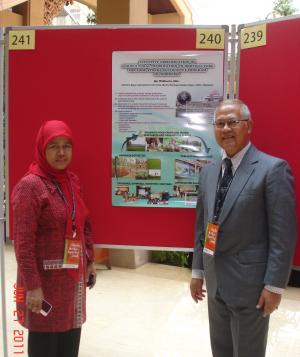
2 (two) Delegates of Bogor Agricultural University at the 2nd International Symposium on Underutilised Plant Species: Crops for the Future – Beyond Food Security, Kuala Lumpur, Malaysia, 27 June – 1 July 2011
Discussing food problems in Indonesia is challenging to all of us, especially in relation to Indonesia’s population growth and its economic development. Within the next two decades, the population of Indonesia is projected to be 258.2 million. Thus, the need for food will dramatically increase. Consequently, the Government should also increase food stocks at least at a rate higher than the projected population growth. Agricultural productivity should be increased accordingly. However, concomitantly industry, housing, and other sectors must also expand and call for land resource availability. These conflicts have created a major problem that must be addressed to guarantee that resources will be sufficient at least to provide food security of the growing population.
In order to establish networks and share experiences with colleagues both in developed and developing countries, as well as to update the “State of the Art” of innovations in the horticulture and its related fields, under the funding support of the organizing committee, Prof. Dr. Ir. Satriyas Ilyas, MS., Head of the Graduate Study Program in Seed Science, and Mr. Widharto, MLs., retired librarian and who is currently the translator for the University web and the English lecturer of MKDU had been awarded the travel grant to attend the 2nd International Symposium on Underutilised Plant Species: Crops for the Future – Beyond Food Security, Kuala Lumpur, Malaysia, 27 June – 1 July 2011. The two delegates presented their posters, Mr. Widharto on “Effective Dissemination of Agricultural Information on Horticulture for Food Stocks Sufficiency Program in Indonesia”. and Prof. Satrias on “Effect of Seed Maturity and Invigoration on Seed Vigor, Plant Growth, and Yield of Bambara groundnut (Vigna subterranea L.).
The international conference took place at the Royale Chulan Kuala Lumpur Hotel. This conference was attended by more than 300 (three hundred) delegates from all over the world. The conference was officially opened by the Prime Minister of Malysia, Prime Minister Datuk Seri Najib Tun Razak. In term of the speakers invited to the conference, they were really world class profession, such as Prof. M S Swaminathan, of the Swaminathan Foundation and other prominent people. The Organizing Committee had designed atmosphere that delegates able to meet and talk with their colleagues from other countries in an informal and pleasant atmosphere. The aim of the conference is to promote and encourage research and education in all branches of holticcultural science and to facilitate cooperation and knowledge transfer on a global scale. The conference was divided into 5 (five) themes as follows: (1). Nutritional, processing and end-user values; (2). Economic and marketing potential – building value chains; (3). Physiology, agronomy and agroecological potential; (4). Biotechnology, breeding and seed systems; and (5). Strategic approaches for research and development.
Apart from the professional benefits gained from the Conference, the contact with other colleagues agricculturists from all over the world, especially from Malaysia provided an insight into their social activities, culture, and the philosophical outlook. We learned how our neighbor country with smaller number of people had shown her capability to organize such a huge event professionally. Moreover, the strategies, tactics, and how to promote and prepare the agricultural programs were really adaptable in our setting. The conference had really provided ideas how to promote public consciousness in science and technology, especially in Horticulture and its related fields.
Even it was only a short visit, but the conference has given me a wider knowledge on various aspects of life. Management system is well-implemented both in the private and governmental institutions, such as in the transportation systems, university’ lifes, banking systems etc. With regard to agricultural development, particularly the holticultural science, Malaysia is ready to encourage local indigenous communities to cultivate useful indigenous plants for their own uses, as landscape for their surroundings and for awareness and appreciation purposes. Finally, the conference is only the beginning of a network that offers more opportunities in a global scale. Now it’s up to the delegates, to build up that network and avail themselves of its unlimited benefits, especially for the development of agriculture for poverty alleviation and food sufficiency.
Through this message, the author would like to acknowledge Dr. Festo Massawe the Symposium Convener, who had successfully secured funding supports to grant both of us the conference fees amounted to US$ 750.00 (seven hundred and fifty US Dollars) per participant, and for the author, the including his accommodation. His kindnest is highly apprreciated. (Widharto).