IPB University’s Patriot Expedition Team Introduces Precision Village Data, Helps Formulate Village Policies in Semangga
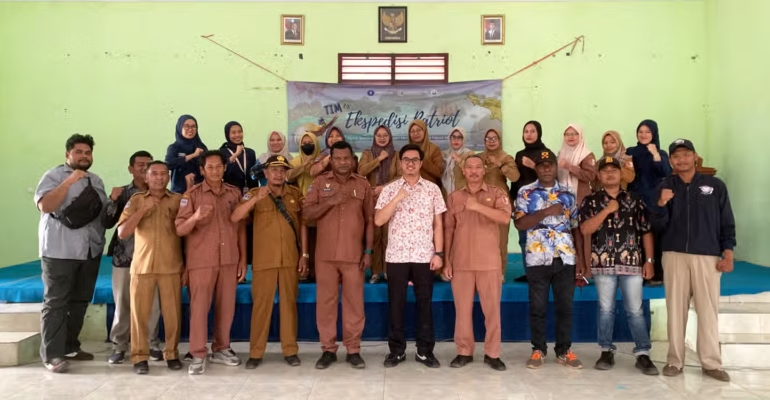
IPB University’s Patriot Expedition Team (TEP) introduced the concept of Precision Village Data to village officials and cadres in Semangga District, Merauke Regency, South Papua.
The event, themed “Utilizing Village Data to Create Precise Village Policies,” was attended by 20 participants at the Marga Mulya Village Hall (10/13–14).
The chief of IPB University’s TEP, Dr Mohammad Iqbal Irfany, explained that this initiative stemmed from challenges frequently encountered in village development.
“So far, well intentioned development efforts have not yielded maximum impact. Roads are built, only to be damaged again. Aid is distributed, but it misses the mark. This happens not because we aren’t working hard enough, but often because policies aren’t based on accurate data,” he said.
The presentation was delivered by Lukman Hakim, SKPm, MSi, an academic from the Faculty of Social Sciences and Human Ecology at IPB University. On the first day, he presented the concept of “Precision Village Data” as an innovative methodology for village data collection.
“Precision Village Data combines participatory censuses, spatial data from drone imagery, and digital technology. Data collection is conducted down to the individual and household levels, enabling villages to understand in detail the conditions of each resident and their location.
Based on this data, village policies can be formulated in a targeted manner, from verifying aid recipients to determining development priorities,” he explained.
On the second day, participants learned about the stages of data-driven policy formulation, ranging from problem identification to the integration of analysis results into the Village Medium-Term Development Plan (RPJM), the Village Government Work Plan (RKP), and the Village Revenue and Expenditure Budget (APB). Participants then practiced setting development priorities for clean water access in two hamlets through group discussions.
Sunaryo, the Village Chief of Marga Mulya, noted that this material addresses real issues in the village. “It has often happened in our village that aid is distributed, but it ends up going to people who are already well-off yet are listed as low-income. This happens because the data is inaccurate,” he said.
Roberto, the Village Chief of Matara, also saw similar benefits. For him, this program was extremely helpful in developing a village development plan.
“Up until now, we in the village have often implemented programs and policies based on intuition. Through this activity, I hope that in the future, villages in Semangga District can be more participatory and actively utilize village data as the basis for policy formulation,” he said.
Through this initiative, TEP IPB University hopes that villages in Semangga District will be able to establish data driven governance so that the resulting policies are more targeted, participatory, and accountable. (*/Rz) (IAAS/KQA)