Making Home Gardens Productive and Waste Valuable: IPB University’s Patriot Expedition Team Trains Women in Kamang Makmur
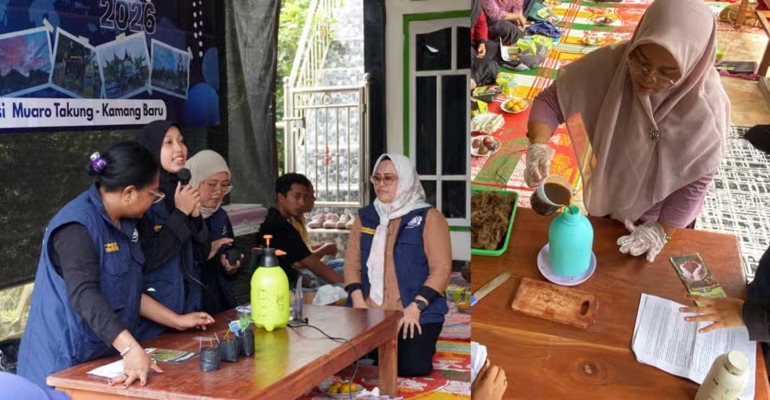
The Patriot Expedition Team (TEP) of IPB University encouraged members of the Women Farmers Group (KWT) and the Family Welfare Movement (PKK) in Nagari Kamang Makmur to make use of the resources available around them, ranging from home gardens to plantation and livestock waste.
Two activities were held at the Bunda Makmur KWT Demonstration Garden in Jorong Timpeh 4, Muara Takung-Kamang Baru Transmigration Area, Sijunjung Regency, West Sumatra, on (10/13).
Chair of the IPB University TEP, Dr Veralianta Br Sebayang, said that the activities aimed to share knowledge and innovations to help the community identify and optimize the resources available in their surroundings.
High Quality Chili Peppers in Home Gardens
The team introduced two chili pepper varieties developed by Prof Muhamad Syukur, namely Triwarsana IPB and Bonita IPB. Triwarsana IPB is an ornamental chili pepper variety that produces fruits in three colors, which are yellow, purple, and red, on a single plant. Bonita IPB has a high level of pungency, potentially produces around 156–325 fruits per plant, and is resistant to certain yellow virus diseases.
“Chili pepper cultivation does not require large areas of land. It can also start in home gardens using pots or polybags. We hope the knowledge and skills gained can be applied by KWT and PKK members so that their home gardens become more productive,” said Veralianta.
Participants learned about seed sowing using a mixture of soil, manure, and rice husk charcoal in a 1:1:1 ratio, seedling transplantation, fertilization, and the identification of pests and diseases. The team distributed chili pepper seedlings approximately 20 days after sowing, seeds, and cultivation guide leaflets.
Turning Waste into Compost
In the second training session, Dr Rasidin Karo Karo Sitepu explained that the development of palm oil businesses should take into account the utilization of by-products and waste.
“Oil palm waste has the potential to be developed into products with economic value, one of which is through processing empty fruit bunches into compost. However, business development cannot rely solely on production capabilities. Communities also need to understand business management,” he explained.
During the demonstration, IPB University TEP member Sinta Naria Suryani, SP, guided participants in processing oil palm empty fruit bunches (TKKS) into compost using an EM4 decomposer solution and molasses. Participants also observed the differences between fresh OPEFB and OPEFB that had undergone fermentation for two weeks.
A member of the Bunda Makmur KWT shared that, previously, whole TKKS was spread directly around oil palm plants. “Now we understand that TKKS needs to be chopped and processed first,” she said.
Liquid Fertilizer from Livestock Manure
Ridhatul Alpadli, an oil palm business owner who also raises livestock, demonstrated how to make liquid organic fertilizer (POC) using livestock manure, goat urine, molasses, water, and Trichoderma. According to him, the manure produced by his 16 goats can support fertilization across approximately 10 hectares of oil palm plantations.
The Chairman of Jorong Timpeh 4, Kamang Makmur, expressed appreciation for the activities. “The presence of these Patriot team members has been very helpful to us and has expanded the community’s knowledge,” he said.
Through these activities, IPB University’s TEP hopes to make home gardens more productive, increase the added value of waste, and encourage the downstream development of oil palm commodities in the Muara Takung-Kamang Baru Transmigration Area. (*/Rz) (IAAS/HRD)