IPB University and BPOM Deploy 200 Students for the Food Safety Community Service Programme, Ready to Begin Work in 20 Locations Across Bogor Regency
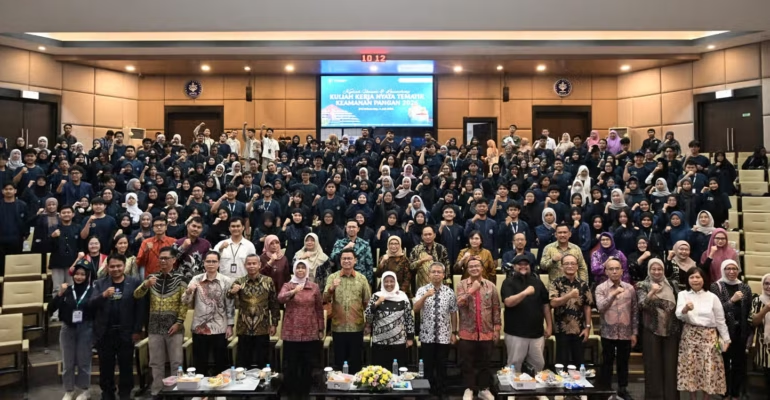
IPB University, together with the Indonesian Food and Drug Supervisory Agency (BPOM), has strengthened its collaboration in fostering a culture of food safety through a public lecture and the send off ceremony for the Food Safety Community Service Programme.
The event, which took place at the Andi Hakim Nasoetion Auditorium, IPB Dramaga Campus, on Saturday (7/4), formed part of the preparatory training for around 200 students who will participate in the Thematic Real Work Lecture (KKNT) on Food Safety in Bogor Regency.
During the public lecture, the Chairman of BPOM, Prof Taruna Ikrar, stated that food safety remains a major challenge in Indonesia. According to the data he presented, one in ten people suffer health problems due to unsafe food.
Globally, around 420.000 people die each year from food poisoning, whilst in Indonesia the economic losses caused by unsafe food are estimated to reach around Rp226 trillion annually.
“Therefore, food security must go hand in hand with food safety. We must ensure that the food available is safe, of high quality and fit for consumption. Our principle at BPOM is simple, if it is not safe, it is not food,” he emphasised.
He added that around 200 IPB University students taking part in the Thematic Real Work Lecture on Food Safety are expected to act as educational agents for the community whilst supporting the strengthening of food safety at village level.
“We hope that students will not only apply the knowledge they have gained on campus, but also help the community understand the importance of food safety. It is this hands on learning experience that will serve as a valuable asset for them,’ he said.
Meanwhile, the Acting Rector (Plh), Dr Heti Mulyati, said that the Real Work Lecture (KKN) is a manifestation of IPB University’s commitment to bringing knowledge and innovation to the community.
“The KKN is not merely about fulfilling an academic obligation, but serves as a learning space for students to live alongside the community, listen to the problems faced by farmers, livestock breeders, fishermen and business owners, and then provide science based solutions,” she said.
According to her, this year’s KKN theme, “Sustainable Development of Agromaritime Communities to Achieve Socio-Resilience”, aligns with global challenges, ranging from climate change to food insecurity. Therefore, building social resilience must begin at the village level through collaboration amongst various stakeholders.
Dr Heti also expressed her appreciation to the Indonesian Food and Drug Authority (BPOM RI) for the trust placed in IPB University to organise the Thematic Community Service Programme on Food Safety across 20 locations in Bogor Regency.
“This collaboration is a manifestation of synergy between higher education institutions, the government, and the business sector to ensure food safety from source to table. We hope this model of cooperation can continue to be developed and replicated in various regions,” she explained.
She urged the students to carry out their community service with humility and to be able to adapt to the local community. “Come not as people who think they know it all, but as brothers and sisters who are willing to learn and work together. Be the eyes and ears that are attuned to the issues facing the community, and uphold the good name of IPB University whilst carrying out the KKN,” she said. (AS) (IAAS/HRD)