
SoraHita, An IPB University Student Program to Develop Functional Communication Skills for Children with Intellectual Disabilities
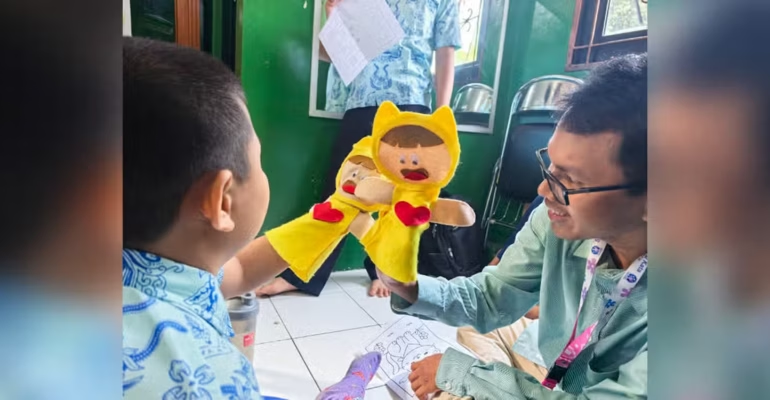
The ability to clearly express one’s needs is a crucial part of everyday communication, including for children with intellectual disabilities. A team from IPB University’s Student Creativity Program in Community Service (PKM-PM) developed SoraHita to help children understand and express their needs concretely in daily life.
The program, implemented at the BC Mekarsari 2 Special Education School (SLB) in Bogor, involved 14 children with intellectual disabilities as participants. The results of the intervention showed that 85,71 percent of the children demonstrated improvement in organizing their words more coherently to express their desired needs.
Parents have also begun to notice these changes in their children’s daily communication. “After the program yesterday, thank God, my child is now able to use words that match exactly what they want,” said one parent of a child participating in the SoraHita program.
Responses Do Not Yet Match the Message
Anjani Natalia, the team leader, explained that SoraHita was designed in response to the communication challenges faced by children with intellectual disabilities, who still struggle to understand messages and provide contextually appropriate responses. Together with her four colleagues, she developed SoraHita under the guidance of Dr Adisti PP Hartoyo.
Based on an interview with one of the instructors before the program was launched, most children with intellectual disabilities were able to respond but did not yet demonstrate an understanding of the messages they received. This situation can lead to a mismatch between the children’s needs and the responses they receive.
“This can then lead to misunderstandings in interactions. Therefore, through this program, we focus on the ability to understand and express needs concretely in daily life,” said Anjani.
Learning Words in Context
SoraHita uses an approach tailored to each child’s abilities. One component of SoraHita, “SoraKata: Suara Asah,” is designed to help children understand and use words to form simple communications. The learning process is carried out in stages: Personal Words, Action Words, and Complete Sentences.
“In the Complete Sentences stage, children are trained to combine the subject, the word “want”’ and a word indicating the object or desired activity. The learning process uses KataSora Cards and the KataSora Board through storytelling and role playing activities with the SoHi puppet,” said Anjani.
She continued, explaining that children are guided to recognize simple situations, select the appropriate cards, and then arrange them based on the given context. The team also provides gradual prompts and reinforcement tailored to each child’s individual abilities.
Through this program, Anjani and her team hope that the KataSora Card and KataSora Board will continue to be used by teachers and parents as tools to support children’s communication. It is hoped that continued use of these tools will help children apply the communication skills they have practiced in their daily activities. (*/Rz) (IAAS/LAN)

