Once Sold Bread to Make Ends Meet, Pandu Yoga Pratama Is Now IPB University’s Top Graduate
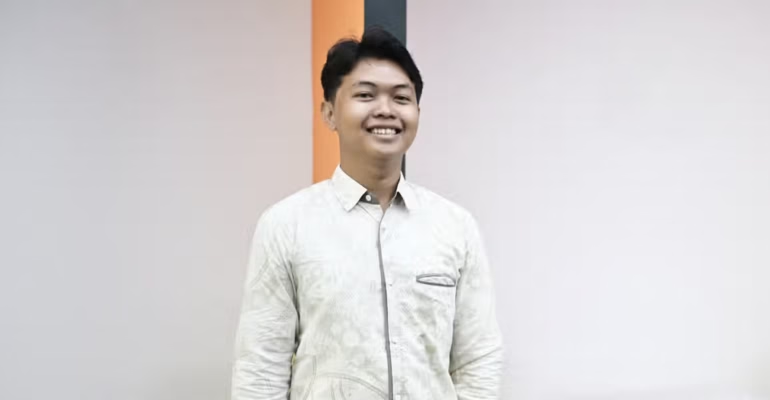
Pandu Yoga Pratama, a graduate of the Forest Management Program at the Faculty of Forestry and the Environment (FAHUTAN) at IPB University, has been named one of the university’s top graduates.
Behind this achievement lies a story of struggle during his time as a student, including selling bread to cover his daily expenses.
Pandu said that studying at IPB University was a blessing for his extended family. He became the first person in his family to attend a public university.
His father works as a kitchen worker, and his mother is a homemaker. From his family, he received a message that he still holds dear today: to always believe in his own potential.
His journey at IPB University wasn’t always easy. By his fourth semester, his family’s financial situation had deteriorated. From that point on, Pandu worked to cover his daily expenses on his own by selling bread to his friends on campus.
“There was a phase when my family’s financial situation took a turn for the worse at the start of my fourth semester. Since then, I’ve tried to cover my own daily expenses while in college by selling bread to my friends every day,” said Pandu.
According to him, the support he received from his friends during college was one of the most meaningful things. The environment at IPB University, filled with students from various regions, not only broadened his horizons but also shaped his character.
“I’m very grateful to have met supportive and open minded friends. The diversity of my friends’ regional backgrounds helped shape my knowledge and character through the environment at IPB University,” he said.
He also expressed his gratitude to his friends who supported his efforts, including by buying the bread he sold.
Inspired by Walden Book
Pandu chose Forest Management because he was inspired by Walden Book, a book by Henry David Thoreau. The book helped him see the forest not merely as a silent, empty space, but as a form of life that is interconnected and provides benefits to humans.
“My most memorable experience was interacting extensively with communities that live off and depend on forest resources. Through direct community service and social research, I gained truly meaningful experiences,” he said.
Together with his colleagues, he designed and implemented a community empowerment program in Karacak Village, Leuwiliang Subdistrict, Bogor Regency, through the Student Organization Capacity Building Program (PPK Ormawa). This experience earned him the Abdidaya Ormawa award for two consecutive years, as well as an award for the team with the second best record of community service.
Although he has graduated, his spirit of service continues. Currently, he is focusing on volunteering for an empowerment program at Lake Lido, Cigombong Subdistrict, Bogor Regency. Much of his time is spent mentoring low-residue tilapia farming, managing household waste, and establishing community oversight groups (pokmaswas).
Pandu’s journey proves that economic limitations do not prevent someone from achieving success. For him, support from his community, a willingness to work hard, and belief in his own potential are crucial elements in achieving his goals. (dh) (IAAS/HRD)