IPB University Promotes Impactful Food Research through The 9th International Food Ingredients Asia Conference
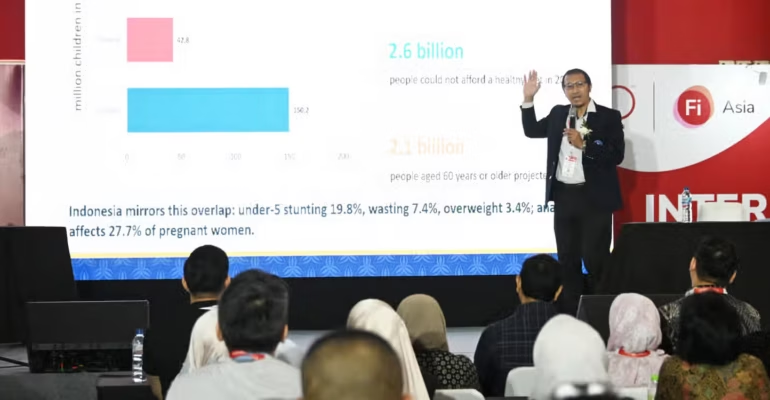
The Southeast Asian Food and Agricultural Science and Technology Center (SEAFAST) of the International Research Institute for Food, Nutrition, Health, and Halal (LRI PGKH) at IPB University held The 9th International Food Ingredients Asia Conference (FiAC) 2026 at the Jakarta International Expo (JIEXPO) Kemayoran, Jakarta, (9/16–18).
The conference served as a platform for collaboration to strengthen food innovation based on scientific evidence, nutrition, health, and sustainability. The event was organized in collaboration with the Indonesian Food Technologists Association (PATPI/IAFT), the Indonesian Food and Beverage Producers Association (GAPMMI), and the Division of Food Science and Technology, Faculty of Engineering and Technology at IPB University.
The Chairmanof SEAFAST IPB University, Dr Puspo Edi Giriwono, stated that FiAC provides an opportunity to connect research findings with real world needs.
He explained that the conference, which has been held since 2010, continues to focus on bridging laboratory findings with business model development, scaling up, and implementation that delivers tangible impacts for society.
“This is an opportunity to communicate, ask questions, listen, and seek solutions together,” he said.
FiAC 2026 brought together academics, industry representatives, government officials, professional associations, students, and young researchers through plenary and technical sessions, poster presentations, student competitions, a nutraceutical program, an academia to business program, and a halal forum.
The conference also featured Dr Ranjan Jha from Nutrition International, who discussed food fortification in the transformation of food systems, as well as Han Yin Leong from Food Industry Asia, who addressed food processing for fortification, reformulation, and improving public nutrition.
On the occasion, the Rector of IPB University, Dr Alim Setiawan Slamet, stated that changes in the global food system have created increasingly complex challenges.
Population growth, climate change, pressure on natural resources, changing consumption patterns, food safety risks, as well as increasing malnutrition and diet related diseases require cross-disciplinary and cross sectoral approaches.
“Evidence based innovation must serve as a bridge between scientific discoveries and their impact on society. Such a bridge can only be built through collaboration,” said Dr Alim in his remarks delivered through video tapping.
According to him, advances in food technology offer opportunities through food ingredient innovation, fortification, reformulation, functional foods, biotechnology, processing technology, artificial intelligence, as well as new approaches to food safety and quality.
However, these innovations need to be supported by scientific evidence, address nutritional and health needs, be safe for consumers, environmentally responsible, economically viable, and applicable on a broad scale.
The Chairperson of LRI PGKH IPB University, Prof Erika B Laconi, emphasized the importance of a research ecosystem that connects these various fields. She explained that LRI PGKH coordinates the development and implementation of national and international research through IPB University’s centers of excellence in food, nutrition, health, and halal studies.
The ecosystem encompasses various centers of excellence, including the Center for Tropical Horticulture Studies (PKHT), Center for Tropical Animal Studies (CENTRAS), SEAFAST Center, Center for Tropical Biopharmaceutical Studies (TropBRC), and Halal Science Center. “A multidisciplinary approach is necessary because a resilient food system cannot be built through standalone solutions,” she said. (dr) (IAAS/ADF)