
IPB University and BRIN Launch INNOBRIDGE to Strengthen the Research and Innovation Collaboration Ecosystem
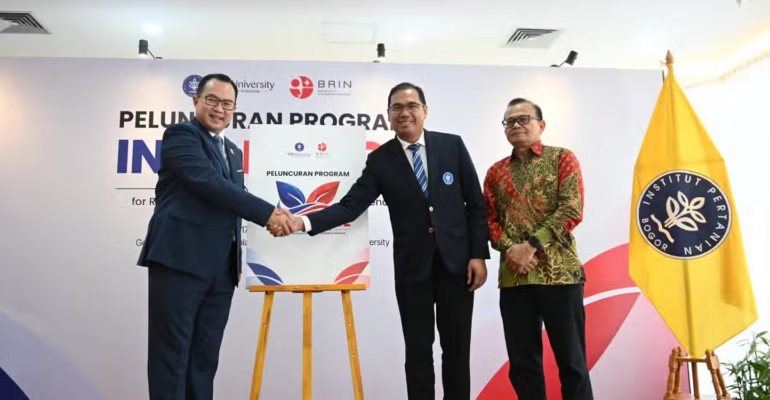
IPB University, together with the National Research and Innovation Agency (BRIN), launched INNOBRIDGE: Innovation Network of BRIN–IPB for Research, Development, and Global Excellence as a platform to strengthen collaboration in research, innovation, and talent development to address national needs and global challenges.
The launch took place at the Halal Business Incubator Building, IPB Science Techno Park (STP), Taman Kencana Campus, Bogor, Thursday (9/17).
The event was attended and officially inaugurated by the Chaurman of BRIN, Prof Arif Satria, alongside the Rector of IPB University, Dr Alim Setiawan Slamet.
The establishment of INNOBRIDGE builds on the track record of collaboration between the two institutions, which has previously been realized through various initiatives, including Research and Innovation for an Advanced Indonesia (RIIM), the Research Collaboration Center (PKR), and the Strategic Invitation Research Program (PRIS). In recognition of this collaboration, BRIN also presented an award to IPB University as the Top Collaborator for 2021–2024.
IPB University Rector Dr Alim Setiawan Slamet stated that INNOBRIDGE is expected to serve as a bridge connecting research and innovation with the real needs of society. According to him, this step is crucial for bridging the gap between research outcomes, innovation, commercialization, and their practical application.
“INNOBRIDGE is a bridge that we hope will connect research and innovation with the needs of society,” said Dr Alim.
He explained that Indonesia possesses vast natural resources, biodiversity, talent, and economic potential. However, this potential needs to be strengthened through research that not only produces publications but is also capable of generating relevant innovations that deliver tangible benefits.
In line with this, the Chairman of BRIN, Prof. Arif Satria, stated that strengthening collaboration between research institutions and universities is essential for building a research and innovation ecosystem capable of producing more concrete impacts.
According to him, the collaborative experience between IPB University and BRIN serves as a pillar for developing more integrated cooperation through INNOBRIDGE. “Collaboration with universities is inevitable. It has become an inevitability,” said Prof Arif.
He explained that INNOBRIDGE is not only intended as a platform for research collaboration but can also be developed to support talent capacity building, including postdoctoral programs, student talent development, and research activities for students. “Thus, the ecosystem being built is expected to bring together researchers, academics, students, infrastructure, and strategic research agendas,” he said.
Three Areas of Collaboration
For your information, INNOBRIDGE focuses its collaboration on three main clusters: Food and Agriculture; Halal and Health; and Bioenergy, Climate, and Fisheries and Marine Affairs. Its development priorities include rice, garlic, oil palm, soybeans and their substitutes, smart agriculture, poultry and animal feed, halal, One Health and zoonoses, functional foods, biomedical products, bioenergy, carbon and climate, fisheries and marine affairs, urban-rural studies, and The Commons.
As a concrete step, the launch of INNOBRIDGE was also marked by the signing of contracts for three PKR programs: the Collaborative Research Center for Next Generation Feed Additives for Sustainable Livestock Systems, CLARITY (Climate Livestock Action for Reducing Emissions in Tropical Systems), and the PKR program in Science and Technology (Halal).
These three programs reinforce the collaborative agenda between IPB University and BRIN researchers in the development of sustainable livestock feed, the reduction of emissions in tropical livestock systems, and the strengthening of halal research. (dr) (IAAS/EPK)

