Kimpul Is More Than Just a Tuber, IPB University Researcher Highlights Its Potential as a Functional Food
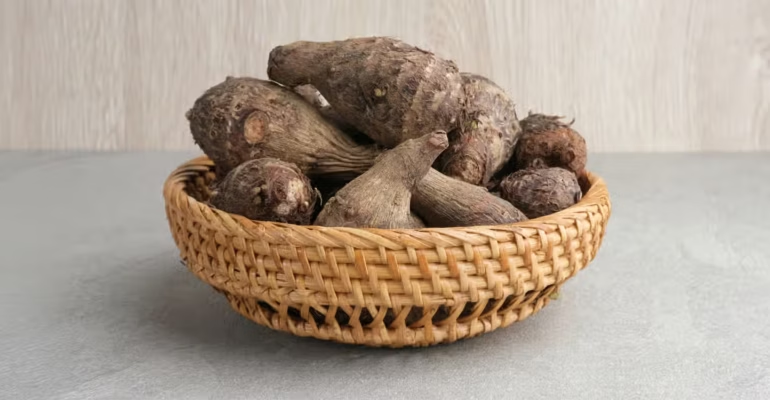
Kimpul, a local Indonesian tuber also known in some regions as belitung or talas belitung, has significant potential to be developed as a local food commodity. The crop is easy to cultivate, can be grown as an intercrop, and has relatively simple processing characteristics.
Professor at the Faculty of Engineering and Technology, IPB University, Prof Titi Candra Sunarti, said that kimpul has the potential to be developed into functional foods and as a raw material for gluten free food products.
The Advantages of Kimpul
“Kimpul is easy to grow and does not require special land. It can also be cultivated as an intercrop because it does not grow too tall. Its processing is simple, it can be boiled or steamed and consumed directly,” said Prof Titi.
Prof Titi explained that kimpul resembles taro, although the two are different plants. The distinction can be identified, among other characteristics, by the appearance of their leaves and tubers.
In kimpul, the main tuber can develop into more than one daughter tuber on a single plant, whereas taro generally produces only one corm.
According to her, the ease of processing is one of kimpul’s advantages. The tuber can be consumed directly as food or processed into various products, such as perkedel (fried mashed tuber patties), chips, and flour.
However, its utilization needs to be supported by greater public awareness regarding the commodity’s different names. In several regions, kimpul is known by different names, including belitung and talas belitung.
From a nutritional perspective, Prof Titi said that tubers generally contain lower levels of protein and fat than cereals, making them less suitable as a sole source of nutrients. Therefore, kimpul consumption should still be complemented with protein sources and other foods to ensure a more balanced nutritional intake.
Nevertheless, kimpul has potential as a food with functional properties. Its carbohydrate content not only serves as a source of energy but may also contribute to a longer lasting feeling of satiety.
“This characteristic makes kimpul potentially useful as part of a dietary pattern that takes blood glucose control into consideration,” she said.
Low Oxalic Acid Content
Prof Titi explained that kimpul does contain oxalic acid, but in relatively small amounts compared with other types of tubers, meaning it does not cause an itchy sensation in the mouth. “It does contain oxalate, but only in small amounts. Therefore, it does not cause itching in the mouth,” she said.
In certain tubers, she explained, oxalate can occur as needle like crystals that cause an itchy sensation. These compounds can be reduced through treatments such as soaking in saltwater or limewater, followed by cooking.
Potential for Gluten Free Foods
The potential for developing kimpul, she continued, is even greater when it is directed toward specialized food products, including gluten free foods.
“If there is excess production, it can then be processed into flour. The flour can subsequently be used as an ingredient in various food products,” she said.
However, such development requires support from the processing industry and a sustainable supply of raw materials.
According to Prof Titi, local food diversification has faced challenges because the tuber based flour industry has not developed on the same scale as the wheat flour industry.
Therefore, strengthening the supply chain, standardizing raw materials, and developing value added products are key to ensuring that kimpul can evolve beyond a local food into a high value economic commodity. (dr) (IAAS/CAA)