Success in Creating Green Jobs, IPB University Students Win Award from Bappenas at IGJC 2026
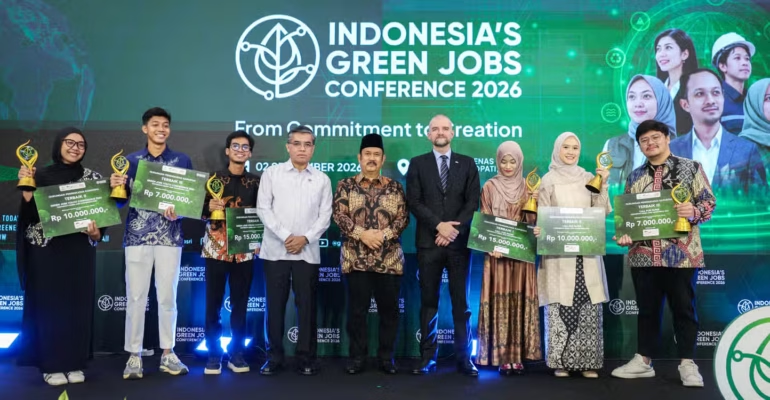
A team of IPB University students from the AgroLoop group won second place at the Green Jobs Youth Innovation Showcase, one of the events in the Indonesia’s Green Jobs Conference (IGJC) 2026 series, themed “From Commitment to Creation.”
This annual conference was organized by the Ministry of National Development Planning/National Development Planning Agency (Ministry of PPN/Bappenas) in collaboration with the Deutsche Gesellschaft für Internationale Zusammenarbeit (GIZ) through the Indonesia–Germany cooperation project “Green Jobs for Social Inclusion and Sustainable Transformation” (GESIT), held at the Bappenas Building in Jakarta on Wednesday, (9/2).
The team is led by Nava Olivia Rahmah, Nasywa Nur Arsanda, Arya Ardhiyaksa Satari, and Ilham Rizky Maulana. All four are recipients of the Sobat Bumi Scholarship from the Pertamina Foundation, who developed AgroLoop under the AgroWaste Group.
“AgroLoop is an integrated livestock-agriculture business innovation based on the principle of zero waste. Every year, we process 438 metric tons of cow manure into standardized liquid organic fertilizer and 2.883 cubic meters of environmentally friendly biogas.
This initiative helps farmers restore the fertility of 187 hectares of land damaged by chemical exposure, while also reducing methane emissions by up to 47,35 metric tons of CO2 equivalent per year to support decarbonization goals,” said Nava.
Creating Green Jobs
He explained that AgroLoop’s main strength lies in the empowerment of the surrounding community. AgroLoop has also created 56 green jobs and provided eco-friendly skills training to more than 150 farmers and rural youth.
Biogas energy is channeled directly to three local food-based micro, small, and medium enterprises (MSMEs). Meanwhile, women from the Family Welfare Empowerment (PKK) program are involved in managing a refill station that recycles 600 used bottles each month.
“From a business perspective, this innovation has also proven to be viable, with a net present value (NPV) of 65,89 million rupiah, an internal rate of return (IRR) of 35,2 percent, a return on investment (ROI) of 256,5 percent, and a payback period of three years, with a revenue growth trend reaching 218 percent,” he added.
In addition to being named 2nd Place Winner, the AgroLoop team also earned the opportunity to serve as a speaker at Parallel Session III of IGJC 2026, where they presented their innovation story directly to green job stakeholders.
Nava and the team also had the opportunity to present AgroLoop directly to the Minister and ViceMinister of National Development Planning/Head of Bappenas, Dr Rachmat Pambudy and Febrian Alphyanto Ruddyard.
The AgroLoop team has developed a sustainability roadmap through 2029, covering everything from product standardization and legal compliance, circular integration with micro-industries, the expansion of partnerships and educational tourism in five regencies and cities in West Java, to the goal of replicating the model across ten national livestock clusters as a contribution to the agenda of food self sufficiency and sustainable energy.
“Hopefully, AgroLoop can continue to grow and be replicated more widely, so that livestock waste, which has long been a source of pollution can truly be transformed into clean energy, restore the health of Indonesia’s agricultural soil, and revitalize the circular economy from the village level to the national scale,” concluded Nava. (*/Rz) (IAAS/LAN)