Is It True That Hair Dye Increases the Risk of Breast Cancer by Up to 60 Percent? Here’s What a Professor from IPB University’s Faculty of Medicine and Nutrition Has to Say
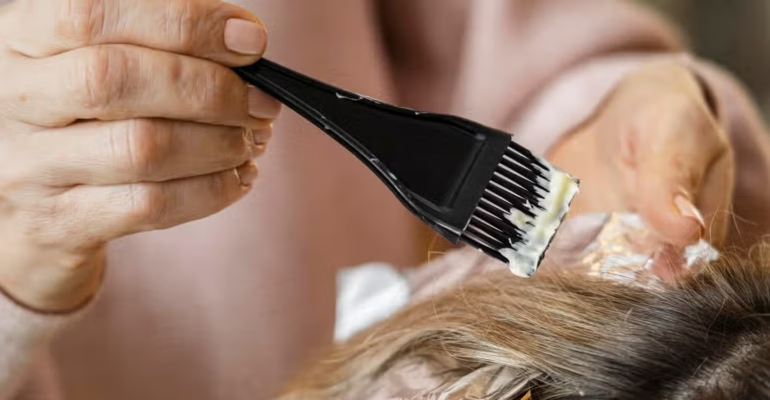
Recently, there has been widespread discussion online about the risk of breast cancer potentially increasing by up to 60 percent among hair dye users. This figure comes from the Sister Study, which involved 46.709 women and was published in the International Journal of Cancer.
dr Samuel Stemi, MBiomed, AIFO-K, Dipl AAAM, a lecturer at the Faculty of Medicine and Nutrition (FKGiz) at IPB University, weighed in on the issue. According to him, although the findings come from scientific research, they must be interpreted with caution.
“This figure must be interpreted with caution. It represents a relative risk increase, it does not mean that 60 percent of hair dye users will develop breast cancer. Furthermore, this study is observational in nature, so it demonstrates an association, not a proven cause and effect relationship,” he said.
The Sister Study found an association between the use of permanent hair dyes and an increased risk of breast cancer. However, this relative risk increase of about 60 percent was found among Black/African American women who used permanent hair dye every 5–8 weeks or more frequently.
“The study participants were not exclusively Black/African American, there were also White women. The study found that, among all participants, the use of permanent hair dye within the 12 months prior to joining the study was associated with an approximately 9 percent increased risk.
For White women, the increase was about 7 percent, while for Black women, it was about 45 percent. The 60 percent figure applies to the Black group who used permanent dye every 5–8 weeks or more frequently,” dr Samuel explained in detail.
According to him, the scientific evidence regarding the link between hair dye and breast cancer is also not entirely consistent. A meta-analysis combining 14 studies with more than 210.000 participants found an overall risk increase of about 7 percent.
“Some studies have found an association between the use of permanent hair dye, particularly frequent use, and an increased risk of breast cancer in certain groups, but it cannot yet be concluded that hair dye directly causes cancer,” he added.
Are Chemicals the Cause of Cancer?
He explained that hair dye contains various chemicals with different formulations. One group of concern is aromatic amines, including p-phenylenediamine (PPD). However, the presence of a chemical in a product does not automatically prove that it causes cancer in humans.
dr Samuel explained that hair dye formulations have also changed significantly since the 1970s, with a number of substances known to be carcinogenic having been removed or restricted.
The International Agency for Research on Cancer (IARC), under the auspices of the World Health Organization (WHO), classifies the personal use of hair colorants as “not classifiable as to carcinogenicity to humans” because there is insufficient evidence in humans. This differs from occupational exposure as a hairdresser or barber, which is categorized as probably carcinogenic.
According to dr Samuel, the public need not panic, but should still exercise caution when using hair dye. Using legal products, following usage instructions, not using them more frequently than necessary, and ensuring the scalp is not injured or irritated are risk reduction measures that can be taken.
“If someone dyes their hair occasionally, there is no strong scientific basis to suggest they should fear developing breast cancer because of that activity.
However, for very frequent use over many years, especially with permanent products, it makes sense to consider reducing the frequency and choosing products with a good safety profile,” he said.
He also emphasized that public attention should be directed toward breast cancer risk factors with stronger evidence, such as age, family or genetic history, postmenopausal obesity, alcohol consumption, physical activity, as well as hormonal and reproductive factors.
“So the principle is don’t panic, but minimize unnecessary exposure. Hair dye isn’t something to be afraid of, but it should still be used wisely.
Current evidence is insufficient to conclude that hair dye directly causes breast cancer, but the presence of risk signals in some studies suggests that excessive and unnecessary use should be avoided,” he concluded. (dh) (IAAS/WSG)