IPB University Expert Explains the Impact of Volcanic Ash on Crops and Farmland
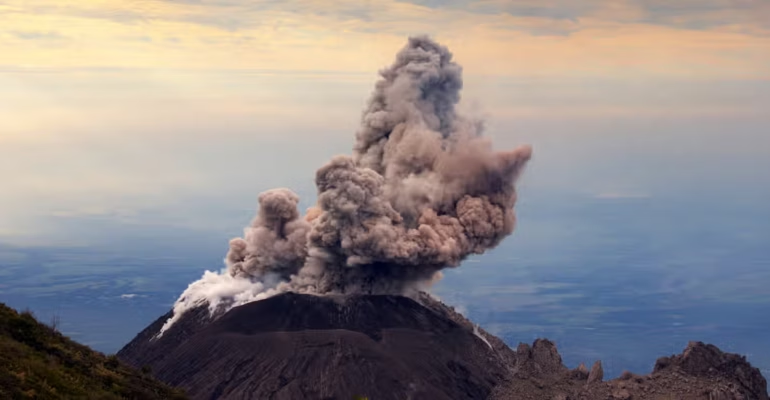
Prof Iskandar, a soil science expert at IPB University, said that the impact of volcanic ash on crops depends heavily on how long the crops are exposed to the ash. The longer the disruption lasts, the greater the potential for damage.
“If the disruption lasts for days or even weeks, the impact will be severe,” he said during an online interview in Bogor on Monday (9/ 7).
Disruption of Photosynthesis
According to him, when a plant’s leaves and stems are covered in volcanic ash, the photosynthesis process is disrupted because the stomata are blocked by a layer of ash. This condition can hinder plant growth and development, depending on how long the volcanic ash remains on the leaf surface. “Plants may fail to flower and result in crop failure,” he added.
Prof Iskandar explained that the impact of volcanic ash on plants is also influenced by the distance from the eruption center. In areas relatively close to the eruption center, falling volcanic ash is still hot enough to cause physical damage to plants.
“At relatively close distances, volcanic ash is still quite hot and can cause physical damage. Plants wither and eventually die,” he said.
He explained that how long volcanic ash remains on the ground also depends on rainfall. Volcanic ash, especially when it forms a thin layer, is relatively easily washed away by rainwater.
The farther from the eruption center, the finer and lighter the volcanic ash particles generally become. Meanwhile, near the eruption center, the ejected material is no longer in the form of dust but can range from sand and gravel to large chunks of rock.
Regarding the management of farmland affected by volcanic ash, Prof Iskandar recommended that the land be tilled immediately after the ashfall ends and the community can resume normal activities, especially if the layer of ash covering the land is relatively thin.
However, if the ash layer is quite thick, tilling the soil will be more difficult. According to him, volcanic ash should not be discarded immediately but can be mixed with the soil. Next, soil conditions need to be checked, including through measurements of pH and electrical conductivity (DHL).
On the other hand, Prof Iskandar noted that the spread of volcanic ash can also be a natural process that has the potential to help restore the fertility of degraded soil.
“Once the volcanic ash on the soil surface comes into contact with rainwater, it releases various elements that serve as plant nutrients, such as calcium (Ca), magnesium (Mg), potassium (K), and others,” he explained.
Therefore, he hopes the volcanic ash “rain” does not last too long so that the community can resume their normal activities and agricultural land can be restored as soon as possible.
“So hopefully this volcanic ash ‘rain’ won’t last too long, the community can resume their normal activities, and the soil will become fertile again,” he concluded. (dh) (IAAS/EPK)