
PEPSILI 2026 National Conference at IPB University, Rector: Science Must Be the Foundation for Addressing Environmental Challenges
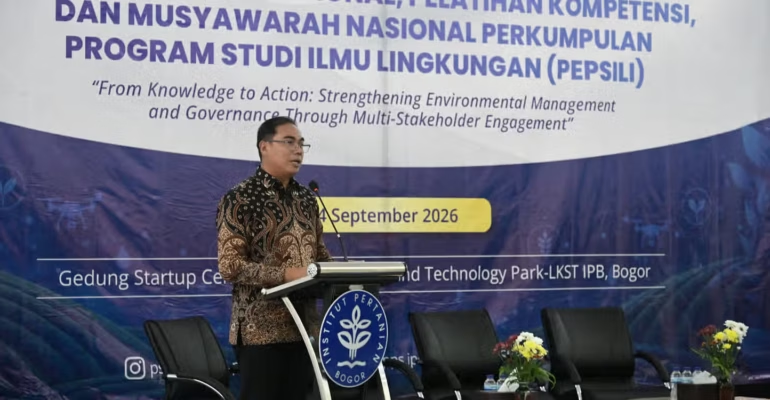
IPB University hosted the “2026 International Workshop, Competency-Based Training, and National Conference (Munas) of the Association of Indonesian Environmental Science Study Programs (PEPSILI).”
The event, attended by 118 participants from 36 universities, served as a collaborative forum to strengthen the role of environmental science in driving policies and concrete actions toward sustainability.
At the forum, IPB University Rector Dr Alim Setiawan Slamet emphasized that the various environmental issues currently faced require a strong connection between knowledge and concrete action. According to him, science must serve as the foundation for every step and decision taken to address environmental challenges.
“Knowledge without action will not bring about change, while action without knowledge can lose its direction. This forum serves as a bridge between theory and practice, between research and implementation, and between the university and various stakeholders,” he said while opening the PEPSILI National Conference at the Startup Center Building, IPB Taman Kencana Campus, on Thursday (9/3).
He said that universities play a vital role in generating knowledge while ensuring that research and scientific findings provide tangible benefits to society and the environment. Therefore, collaboration among universities, the government, the business sector, and various stakeholders is essential in addressing increasingly complex environmental issues.
“This forum is not only a place to exchange knowledge but also a space to build collaboration. Environmental challenges know no territorial boundaries, so the solutions we develop also require strong cooperation and synergy,” he said.
The rector also hopes the forum can serve as a platform to strengthen collaboration and synergy among universities in advancing sustainability in Indonesia. “Let us turn knowledge into action, and action into a sustainable impact for the environment and society,” he said.
Meanwhile, the Deputy for Environmental Management and Sustainable Natural Resources at the Ministry of Environment/Environmental Management Agency, Ir Sigit Reliantoro, MSc, noted that the greatest challenge in environmental management today is not due to a lack of scientific knowledge, technology, data, or regulations in Indonesia.
“The main challenge is ensuring that all this knowledge can be translated into concrete decisions and ecological changes,” he emphasized.
He cited various environmental issues, including hydrometeorological disasters and forest and land fires (karhutla), which require a shift in perspective regarding environmental governance.
“Putting out fires is a duty, but preventing them from happening again is a sign of successful governance,” he said.
The Dean of the IPB University Graduate School, Prof Yusli Wardiatno, added that universities have a greater responsibility than simply producing scientific knowledge. The knowledge generated, he explained, must be translated into action, policies, and better environmental governance.
This event also served as a platform to strengthen the environmental science education community in Indonesia. Participants not only took part in discussions and workshops but also attended competency based training sessions and the PEPSILI National Conference.
Through this gathering, IPB University hopes to foster new ideas, networks, and collaborations that can make a tangible contribution to strengthening environmental education and governance in Indonesia. (IAAS/LAN)

