IPB University Professor Explains Why the Sun Turns Red Amid Forest and Land Fires
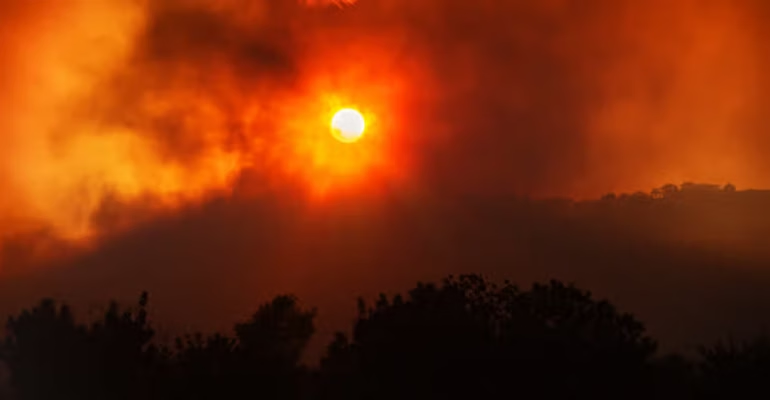
A red or orange sun amid forest and land fires (karhutla) is a sight that often draws attention. This color change is frequently attributed to the smoke billowing into the atmosphere. Is this assumption correct?
According to Dr Givo Alsepan, a professor in the Department of Geophysics and Meteorology at IPB University, smoke from forest and land fires can indeed make the Sun appear red or orange because aerosol particles in the smoke interact with sunlight.
“Simply put, smoke acts like a natural optical filter. Some of the sunlight is scattered and absorbed by the smoke particles, so the light that reaches our eyes is relatively richer in red and orange hues,” he said.
He further explained that sunlight consists of various wavelengths. Under normal atmospheric conditions, air molecules are more effective at scattering light with short wavelengths, such as blue. It is this condition that makes the sky appear blue during the day.
“When smoke from forest and land fires increases the concentration of aerosols in the atmosphere, the interaction of light with these particles becomes more complex. The size, shape, and composition of particles such as soot, ash, and organic material resulting from combustion help determine how sunlight is transmitted, scattered, or absorbed,” he explained.
The phenomenon of a red Sun is usually more dramatic at sunrise and sunset. When the Sun is near the horizon, its light must travel a longer path through the atmosphere than when it is high in the sky.
“The longer the path of light through the atmosphere, the greater the chance that the light will interact with air molecules and aerosols. Therefore, the red or orange hues are usually more intense in the morning and evening,” he said.
However, he emphasized that the color of the Sun as perceived by the human eye cannot be used directly as a measure of smoke concentration or air pollution levels.
“Smoke high enough in the atmosphere can make the Sun appear red, but that doesn’t necessarily mean PM2.5 concentrations at ground level are high. So, the color of the Sun cannot be used as the sole indicator of air quality,” he said.
The color visible from a given location is also influenced by the height of the smoke layer, the size and composition of the aerosols, humidity, clouds, the angle of the sun, and wind conditions. Therefore, assessments of air quality should still be based on official data and information.
“If the sun appears red and is accompanied by haze, visibility is reduced, and there are forest and land fires nearby or downwind, the public should be extra vigilant and check official air quality information,” he said.
Dr Givo also reminded the public of another important point that must not be overlooked: do not look directly at the sun with the naked eye. “Even if it appears dim or red due to smoke, looking directly at the sun remains dangerous,” he concluded. (AS) (IAAS/LAN)