IPB University Unveils Multi Stakeholder Collaboration Strategy to Accelerate the Commercialization of Research Results for Micro and Small Enterprises
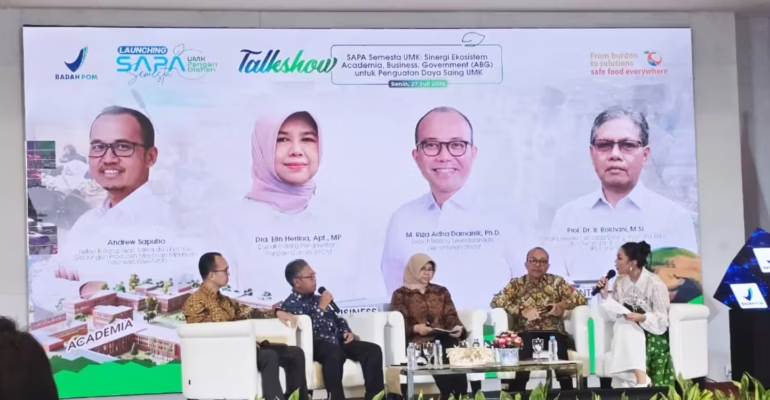
Innovations originating from universities will not have a tangible impact if they remain confined to the laboratory. To enhance the competitiveness of micro and small enterprises (UMK), research results need to be commercialized through multi stakeholder collaboration.
IPB University presented these insights during the SAPA SEMESTA UMK Processed Food BPOM 2026 Talk Show through Prof Rokhani Hasbullah, Vice Chair of the Business Incubator and Industrial Partnership Division at the Institute for Agromaritime Development and Innopreneurship Acceleration (LPA2I), on Monday (7/27).
On that occasion, Prof Rokhani outlined various strategies that IPB University has implemented to accelerate the commercialization of research results.
“Successful commercialization cannot be achieved by universities alone. Synergy between academia, the government, and the business sector is needed so that research results can be developed into economically valuable products while also enhancing the competitiveness of MSMEs,” he said.
He explained that universities serve as generators of research and innovation, providers of education and training, and business incubators that help refine business models. The business sector functions as a commercialization partner by providing market access, technology transfer, and financial support. Meanwhile, the government plays a role in creating conducive regulations, streamlining permitting processes, providing access to financing, and building infrastructure that supports the growth of SMEs.
“This collaboration is key to ensuring that innovations born on campus do not remain confined to the laboratory but truly benefit the community and business actors,” he explained.
IPB University’s Commercialization Ecosystem
As part of implementing this strategy, IPB University continues to strengthen its commercialization ecosystem through the Science Techno Park (STP). The STP serves as a platform for innovation development, technology transfer, and business incubation that supports the emergence of technology based startups while nurturing SMEs to scale up.
The STP’s Teaching Industry facilities are also utilized to support the development of food products, ranging from beverages, biscuits, cookies, baked goods, to pastries, and will be expanded to include herbal ingredients and extracts.
These efforts have yielded positive results. During the 2024–2026 period, IPB University has produced 79 innovative products, with 39 innovations, or about 49 percent, having reached a technology readiness level (TRL) of 7 or higher.
“This achievement indicates that nearly half of the innovations produced are ready to be demonstrated in an operational environment and have the potential to be commercialized and adopted by users, including MSMEs,” said Prof Rokhani.
Additionally, over the past three years, 185 startups have been incubated, with the majority in the food sector. Of the 64 food startups mentored, 16 have successfully obtained marketing authorization from the Indonesian Food and Drug Administration (BPOM), giving them a greater chance of entering the market on a large scale.
IPB University also involves students in various SME mentoring programs, such as internships, Thematic Community Service (KKN), the BIMA Community Service program, Food Patriots, Lecturer Homecoming, One Village One CEO (OVOC), and startup business incubation programs. This involvement is part of efforts to accelerate technology transfer while enhancing the capacity of SME operators in various regions.
At the end of his presentation, Prof Rokhani emphasized that the biggest challenge facing SMEs today remains related to meeting various legal and product licensing requirements, ranging from basic requirements and business permits to halal certification and BPOM distribution permits.
Therefore, he stressed that continuous mentoring through collaboration among universities, the government, and the business sector is key to ensuring that more research results can be commercialized and provide tangible benefits for the development of MSMEs in Indonesia. (*/Rz) (IAAS/WSG)