IPB University’s Department of Marine Science and Technology and Gyeongsang National University Discuss Advances in Underwater Acoustics
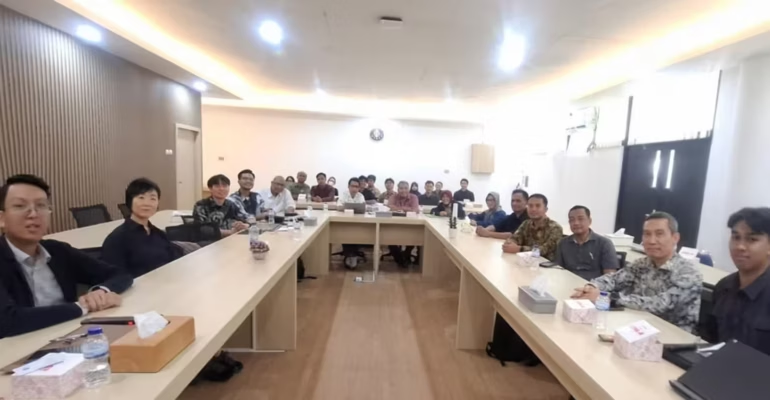
The Department of Marine Science and Technology (ITK), Faculty of Fisheries and Marine Sciences (FPIK), IPB University, held the fourth session of the 3rd International Seminar on Ocean Science and Sustainability (ISOSS 2026).
The Chairman of the Department of ITK at IPB University, Dr Syamsul Bahri Agus, said that the international seminar serves as a platform for academic collaboration between researchers from IPB University and Gyeongsang National University, South Korea, in exploring underwater acoustics for sustainable marine ecosystem monitoring.
“This seminar highlights how modern acoustic technology has become a crucial instrument for observing water column dynamics, classifying seabed sediments, and monitoring the impacts of climate change in real time,” he said.
Marine Monitoring Innovations from IPB University Researchers
The seminar opened with a presentation by Prof Henry M Manik, who discussed the development of education and the direction of underwater acoustics research at IPB University. The IPB University professor emphasized the importance of mastering acoustic technology for Indonesia’s next generation of researchers in safeguarding the nation’s sovereignty and the sustainability of its marine resources.
Next, two young researchers from the Doctoral Program in Marine Technology at IPB University presented the results of their applied research. Dadang Handoko shared his findings on Acoustic Sediment Classification Using High-Frequency (400 kHz) Multibeam Data in Pari Waters, Seribu Islands. The study demonstrated the reliability of high-frequency multibeam data in accurately mapping and classifying seabed sediment types in the Seribu Islands.
Meanwhile, Mohd Rafli Furqan Hidayat presented his study titled Target Strength Analysis and Density Estimation of Kawakawa (Euthynnus affinis) Using a Broadband Echosounder, which utilizes a broadband echosounder to efficiently estimate the abundance of kawakawa stocks without harming the ecosystem.
An international perspective was presented by Prof Myounghee Kang from Gyeongsang National University. In her presentation, she emphasized the importance of an integrated acoustic approach for ecosystem characterization and long-term climate change monitoring in global marine waters.
Two doctoral students from Gyeongsang National University, Jihoon Jung and Fredrich Simanungkalit, also shared the results of their global-scale observational research.
Jihoon Jung presented an analysis of long term moored acoustic observations in the Seychelles Chagos Thermocline Ridge. His research examined seasonal variability, diel vertical migration, and the interaction between sound scattering layers and environmental conditions.
Fredrich Simanungkalit, an alumnus of the Department of Marine Science and Technology at IPB University who is currently pursuing his doctoral studies in South Korea, presented his research on the seasonal dynamics of the distribution and aggregation of acoustic scatterers in Terra Nova Bay, Antarctica, and their relationship with extreme environmental drivers.
Through the organization of ISOSS 2026, IPB University continues to strengthen its position as a pioneer in sustainable marine research while expanding its global strategic partnerships in marine science. (*/Rz) (IAAS/KAL)