IPB University Partners on Research to Study How Well AWD and Biochar Work Together in Indonesia’s Rice Farming
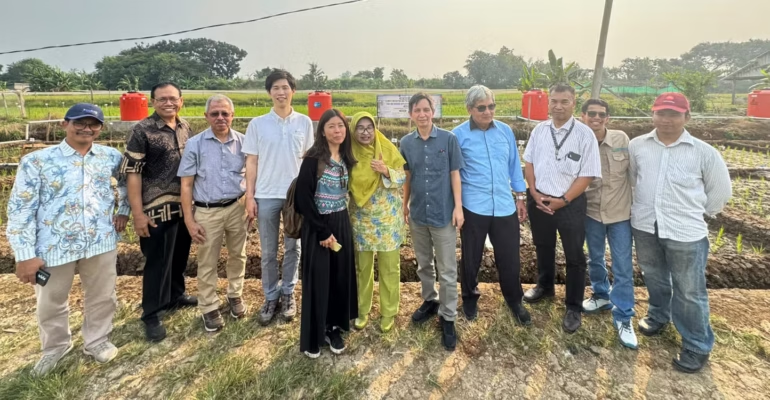
IPB University, together with Faeger Co Ltd and PT Yanmar Diesel Indonesia, has launched a research project to study how combining Alternate Wetting and Drying (AWD) with rice husk biochar can lower greenhouse gas (GHG) emissions while keeping harvest yields stable.
By scientifically testing this combined approach, the project aims to strengthen climate change mitigation in rice farming while also improving how soil and other resources are managed for long term sustainability.
Growing rice is a core part of Indonesia’s food security. As one of the world’s largest rice producers, the country depends on irrigated rice farming to meet domestic needs. But rice farming is also a major source of greenhouse gas emissions in agriculture, especially methane (CH₄), which is produced when fields stay flooded with water for long periods.
On top of that, large amounts of rice husks and other farm waste are produced every year, and much of it is not used well or is simply burned in open fields, creating environmental concerns and wasting a chance to turn it into something valuable.
Chairman of IPB University’s Center for the Development of Engineering Sciences for Tropical Agriculture (CREATA), Prof I Wayan Budiastra, explained that this research project addresses agricultural climate challenges in Indonesia through a combined approach that brings together smart water management with recycling farm waste.
“By using AWD, a controlled water management technique, this project aims to sharply cut methane emissions while also significantly reducing the need for irrigation water,” he said.
At the same time, he continued, the project introduces biochar — turning underused farm waste into charcoal that locks carbon into the soil for centuries. When applied to farmland, biochar acts like a sponge, improving soil fertility, holding on to important nutrients, and improving water retention to directly help keep harvests stable even when the climate is unpredictable.
“By combining AWD and biochar, this study aims to show how these methods can work together to lower emissions while still keeping farming productive and resilient,” he added.
The study began in April 2026 and will run for one year on IPB University’s rice fields as a controlled experiment. Different water regimes and biochar treatments will be tested. Researchers will measure greenhouse gas emissions, including methane and nitrous oxide (N₂O), soil carbon, soil fertility, water use, plant growth, and harvest yields.
The research team will also study whether these practices make economic sense and are practical for local farmers to use. This includes looking at the business potential of processing farm waste into biochar on a large scale, as well as measuring the direct costs and benefits for family farms.
The final goal is to build a solid set of field based data to support future climate mitigation measurement and carbon accounting efforts.
“These findings are expected to help shape evidence based strategies for low emission rice production, and can also provide valuable data for climate mechanisms and carbon crediting frameworks, including the joint crediting mechanism (JCM) and other developing carbon market systems,” said Prof Wayan.
Besides the experiment, the project will also select and evaluate pilot locations to help scale up the approach quickly. The team will look for candidate locations that have organized farmer groups, good irrigation infrastructure, and nearby rice mills that can supply rice husks for biochar.
The project leaders will also actively work with government stakeholders to align the project with national development priorities and climate mitigation goals.
By focusing on the climate mitigation impact and stability of combining AWD and biochar, Prof Wayan hopes this collaboration can build a science based foundation for practices that improve environmental sustainability while also supporting long-term rice productivity in Indonesia. (*/Rz)(IAAS/ST)