IPB University Professors Promote the Commercialization of Halal Collagen Research from Fish Skin to the Community in Tegal
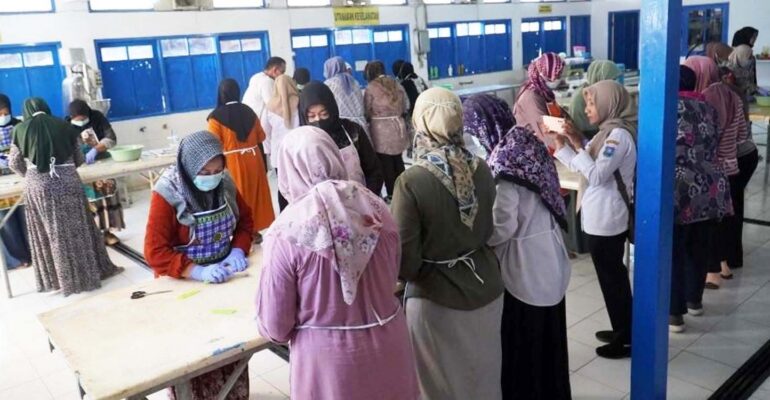
A number of IPB University professors held a workshop on halal collagen and gelatin from fish skin at the Tegal Secondary School of Fisheries (SUPM) on Wednesday (7/1).
The event was held as part of an effort to transform research findings into innovations that can be directly applied by the community. Through the Bestari Saintek program, this activity serves as a manifestation of strengthening research commercialization through cross sector collaboration.
The event was led by Prof Mala Nurilmala, with team members Prof Khaswar Syamsu, Prof Nancy Dewi Yuliana, and Prof Y Aris Purwanto. They developed an innovation to utilize fish skin into hydrolyzed collagen or high-value-added halal gelatin as part of efforts to strengthen the circular bioeconomy and the commercialization of research outcomes.
The leader of the implementation team, Prof Mala Nurilmala, who is also the chair of the Indonesian Aquatic Co-products Association (InCoPro), explained that Indonesia has significant potential in utilizing fishery byproducts, which have not yet been optimally utilized.
“Through this initiative, we aim to demonstrate that fish skin is no longer merely considered waste but can be processed into high-value products such as hydrolyzed collagen or halal gelatin. This technology is expected to create new business opportunities for the community while supporting the development of an industry based on the circular bioeconomy,” she said.
Prof Khaswar, who is also the Chairmam of the Halal Science Center at IPB University, added that collagen and gelatin have traditionally been derived primarily from pigs. Therefore, he emphasized the importance of developing appropriate processing technologies.
“Collagen and gelatin have a wide range of applications in the food, cosmetics, and pharmaceutical industries,” said Prof Nancy, with Prof Aris adding.
The workshop was attended by H. Amiruddin, Lc, Vice Chair of the Tegal City Regional People’s Representative Council (DPRD); a representative of the Chairman of the Tegal City Department of Marine Affairs, Fisheries, and Agriculture (DKPP); Kurnia Adi, SPi, Chairman of the Tegalsari Nusantara Fishing Port (PPN); as well as Henry Iskandar, APi, MSi, and Widiyanto, SPi, MSi, the Chairmam and Vice Chair of SUPM Tegal; SUPM faculty members; and industry representatives from PT Geltech Prima Indonesia.
In addition to presenting the material, these IPB University professors also invited participants to engage in hands on practice at the SUPM Tegal processing laboratory. The participants, who are fish processing business owners from Tegal City, were introduced to the stages of fish skin processing, ranging from the preparation of raw materials for the production process to an introduction to the characteristics of gelatin products.
The participants’ enthusiasm was evident throughout the hands on sessions and discussions. They asked a variety of questions regarding business opportunities, product quality standards, and the potential for developing marketable derivative products.
Through a hands on approach, participants gained an understanding of the importance of applying appropriate processing technologies to produce high quality products with greater market value, rather than selling fish skin as waste or raw material.
This activity also strengthened the synergy between IPB University, SUPM Tegal, the local government, and business actors in supporting the development of an innovative and sustainable fisheries processing industry.
“Through the Bestari Saintek program, we are committed to continuing to deliver innovations that can be implemented by the community and the business sector so that research results do not merely remain in the laboratory but are able to have a tangible impact on improving community welfare and strengthening the competitiveness of the national fisheries sector,” said Prof Mala. (*/Rz) (IAAS/FHD)