IPB University and National Chung Cheng University Strengthen International Collaboration on Gender, Migration, and Community Resilience Issues
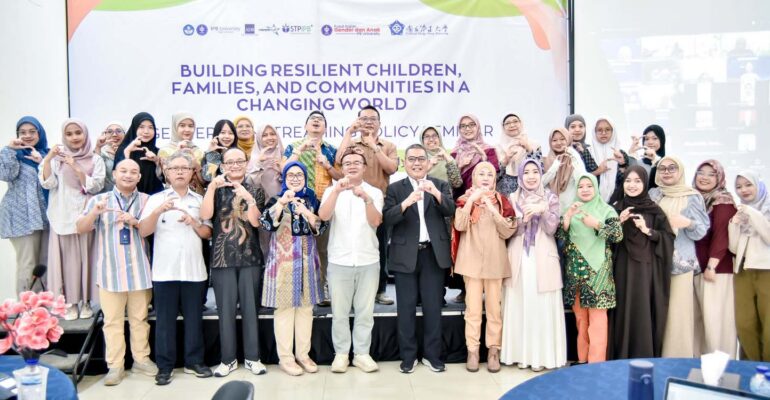
IPB University and National Chung Cheng University (Taiwan) jointly organized the “Building Resilient Children, Families, and Communities in a Changing World: Gender Mainstreaming Policy Seminar.”
The event was held as part of the Promoting Research and Innovation through Modern and Efficient Science and Technology Parks Project (PRIME STeP) on Friday (7/3) at the Startup Center Building, Science and Technology Park, IPB University.
Initiated by the Institute for Agromaritime Development and Innopreneurship Acceleration (LPA2I) and the Center for Gender and Child Studies (PKGA), the seminar featured academics from National Chung Cheng University, namely Prof Ting Wen-Ching and Prof Liu Huang Li-Chuan, as well as Dr Yulina Eva Riany from IPB University.
In his opening remarks, the Chairman of the International Research Institute for Social, Economic, and Regional Development at IPB University, Prof Arya Hadi Dharmawan, stated, “This is a strategic forum to discuss migrant worker protection and gender equality issues while strengthening the implementation of GEDSI (Gender Equality, Disability, and Social Inclusion). This event also marks the beginning of academic collaboration between IPB University and National Chung Cheng University.”
Meanwhile, the Chairman of LPA2I IPB University, Dr Handian Purwawangsa, expressed his hope that the forum would serve as a platform for knowledge exchange and the strengthening of international collaborative networks.
“IPB University is committed to implementing GEDSI principles to build the resilience of children, families, and communities,” he added.
Dr Yulina Eva Riany emphasized that GEDSI is a crucial foundation for building the resilience of children, families, and communities amid various global challenges, including climate change, poverty, demographic transformation, and rapid technological advancement.
“As part of this commitment, IPB University has integrated GEDSI principles into institutional policies and various campus programs to create a safe, equitable, and inclusive environment,” she explained.
During her presentation, Prof Ting Wen-Ching highlighted the vulnerabilities faced by female migrant workers from Myanmar. According to her, the Myanmar government’s restriction on women working abroad as domestic workers, combined with the high demand for labor in Singapore, has instead created various risks, ranging from informal recruitment channels to increased potential for exploitation.
“Female migrant workers face multiple layers of vulnerability due to factors such as gender, migrant status, economic conditions, and nationality. Limited protection from both the country of origin and the destination country forces many workers to rely on informal brokers who often operate outside regulatory oversight. As a result, many prospective workers depart without adequate understanding of their rights, employment contracts, or legal protection mechanisms,” she said.
Next, Prof Liu Huang Li-Chuan explained that the presence of new immigrants in Taiwan has become an important solution for meeting labor demands in the agricultural sector, which is facing significant challenges due to declining interest among younger generations.
“Immigrants not only contribute to the household economies of their countries of origin but also generate positive impacts on economic development and the sustainability of Taiwan’s agricultural sector,” she stated.
Nevertheless, she emphasized the need for the legalization of migrant workers’ status and the development of inclusive migration policies to create a more sustainable labor system while supporting long-term economic development.
Through this seminar, IPB University and National Chung Cheng University hope that their collaboration will serve as a foundation for generating innovations and policy recommendations that strengthen the protection of vulnerable groups while promoting a more just, inclusive, and globally competitive society. (*/Rz) (IAAS/KAL)