Bringing Chili and Tomatoes, Farmers from TNGHS Buffer Villages Consult Pests and Diseases with IPB University Experts
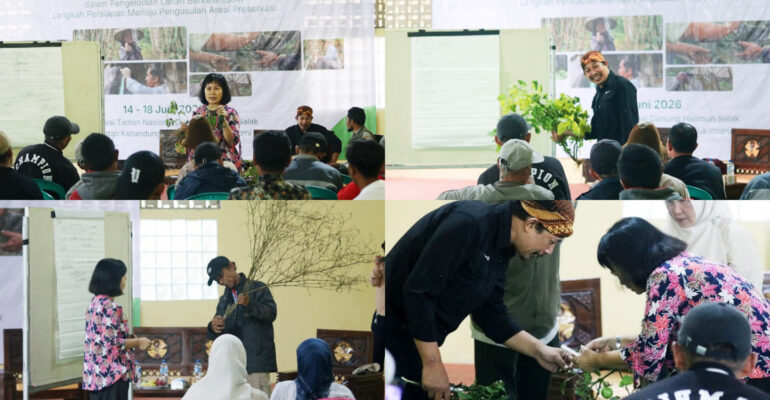
A number of farmers from buffer villages of Gunung Halimun Salak National Park (TNGHS) had the opportunity to consult directly with two IPB University experts. Some of them even brought plants such as chili and tomatoes that were experiencing pest and disease attacks for further identification.
This activity is part of the program on Capacity Building for Farmers of TNGHS Buffer Villages in Sustainable Land Management, a Preparatory Step Toward the Proposed Preservation Area, carried out by the Implementing Partner of FOLU Net Sink of the Department of Conservation of Forest Resources and Ecotourism (KSHE) of IPB University.
The participants took advantage of this opportunity to consult regarding the symptoms appearing on their plants, ranging from changes in leaf color, insect attacks, to diseases causing a decline in productivity.
Through the consultation session, farmers received explanations regarding the symptoms of attacks, their causes, and appropriate control measures suited to the condition of the plants in the field. The training was attended by farmers from four program intervention villages, namely Cihamerang Village, Kabandungan, Cipeuteuy, and Mekarjaya.
Present as speakers were entomology expert Bonjok Istiaji, SP, MSi and phytopathology and mycology expert Dr Efi Toding Tondok. Both are lecturers at the Department of Plant Protection, Faculty of Agriculture, IPB University. The speakers provided explanations on early identification techniques, causative factors, and control measures that can be applied according to conditions in the field.
Farmers as Environmental Heroes
In his presentation, Bonjok Istiaji explained that climate change also affects the development of plant pests and diseases. Changes in temperature, rainfall, and other environmental conditions can trigger the emergence of new types of attacks as well as increase the intensity of attacks by plant-disturbing organisms that farmers have long been familiar with.
According to him, increasing the capacity of farmers in recognizing and controlling plant pests and diseases is becoming increasingly important amid the ongoing challenges of climate change. He also linked the importance of sustainable land management to climate change mitigation efforts that are part of the FOLU Net Sink program.
“What needs to continue to be done is planting and caring for plants. In addition to producing food, plants also play a role in absorbing carbon from the atmosphere. Farmers are truly environmental heroes because they not only produce agricultural products for society, but also help provide fresher air and create a more comfortable environment,” said Bonjok.
Meanwhile, Chief of Kabandungan Sub-district, Lilih Resmiati, SKM, STrKeb, MSi, who was present at the activity, expressed her appreciation. “This training is very much in line with the needs of farmers. Knowledge regarding plant pest and disease control is an important long-term investment for the sustainability of farming businesses.
“The FOLU Net Sink program is also a good example of efforts to preserve the environment while simultaneously increasing community capacity,” she said.
Through this activity, the Department of Conservation of Forest Resources and Ecotourism (KSHE) of IPB University hopes that the knowledge gained by participants can be directly applied on their respective lands, thereby being able to increase agricultural productivity while also supporting conservation efforts in the TNGHS buffer village area. (*/Rz)(IAAS/PRP)