The 4th SNU–IPB Green Bio Science Forum Strengthens Indonesia–Korea Collaboration in Agricultural Research and Food Technology
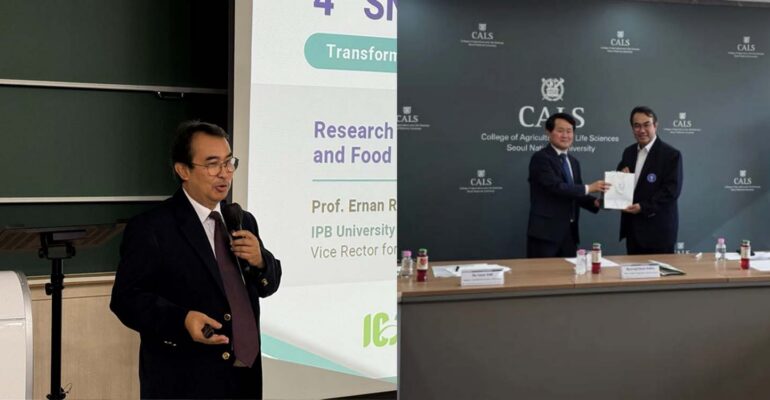
IPB University continues to strengthen its international network through various strategic partnerships with South Korea. This is demonstrated by the hosting of the 4th SNU–IPB Green Bio Science Forum at Seoul National University (SNU) in South Korea, as well as a series of meetings and working visits focused on strengthening agricultural research, food technology, and sustainable school food systems.
At the forum held at SNU, IPB University’s Vice Rector for Research, Innovation, and Agromaritime Development, Prof Ernan Rustiadi, emphasized that global challenges such as climate change, environmental degradation, and food security require international collaboration based on science, innovation, and sustainability.
“The collaboration between IPB University and SNU is a strategic step in strengthening research capacity and the development of future agricultural technologies. This synergy is expected to generate innovations that make a tangible contribution to sustainable agricultural development and national food security,” he said.
During the forum, Prof Ernan outlined IPB University’s research development strategy toward Agromaritime 5.0, grounded in omics science, artificial intelligence (AI), sustainability science, and a techno-socio-preneurship approach. He also highlighted IPB University’s achievement of ranking 48th globally in the Agriculture and Forestry category according to the QS World University Rankings by Subject 2026 and first in ASEAN in that field.
Exploring IPB-CALS Collaboration
Strengthening collaboration was also discussed during a strategic meeting between IPB University and the College of Agriculture and Life Sciences (CALS)-SNU. Both institutions agreed to promote more concrete collaboration through joint research, student and researcher exchanges, laboratory capacity development, international scientific publications, and the development of sustainable agriculture technologies.
“IPB University and SNU share a common vision in advancing agricultural research and innovation to support sustainable food security,” said Prof Ernan.
The Dean of CALS, Prof Byoung Cheorl Kang, also expressed SNU’s commitment to continue strengthening cooperation with IPB University, particularly in the fields of agricultural research, education, and the development of sustainable food technology. According to him, collaboration between the two institutions holds great potential to generate innovations capable of addressing global challenges, particularly regarding food security and climate change.
On that occasion, Prof Do Soon Kim, Head of the Department of Agronomy, Crop Molecular Physiology, and Weed Science, further explained that CALS possesses multidisciplinary research strengths encompassing agronomy, agroeconomics, plant breeding, plant biotechnology, plant physiology, weed science, entomology, plant pathology, and Official Development Assistance (ODA) programs in agriculture and rural development.
Learning About Korea’s Eco-Friendly School Meal Program
In addition to strengthening research, the IPB University delegation also studied South Korea’s sustainable school food system through visits to the Gyeonggi Agro-Fisheries Institute (GAFI) and Maeyang Elementary School. These visits provided insight into the implementation of the Eco-Friendly School Meal program.
Meanwhile, Prof Ernan explained that one of the challenges in implementing the Free Nutritious Meal (MBG) program in Indonesia is linking school food needs with local agricultural activities.
“A nutritious meal program is not only about meeting children’s nutritional needs but must also be able to create a food economic ecosystem that involves local farmers, an efficient distribution system, and sustainable agricultural development,” he said.
This collaboration is expected to make a tangible contribution to food security, sustainable agricultural development, and food technology advancement in Indonesia and the global region. (*/Rz) (IAAS/EXC)