A Source of Pride! IPB University’s ‘MITR Club’ Student Team Wins First Place at IEEE OES 2026
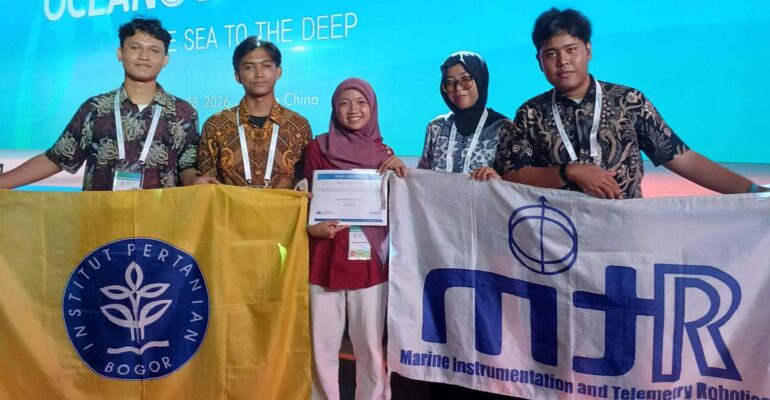
IPB University students have achieved a remarkable feat on the international stage. Students from the Marine Science and Technology (ITK) program, members of the Marine Instrumentation, Telemetry, and Robotics (MITR) Club, secured the First Place Winner title at the IEEE OES Ocean Decades Challenge 2026.
This achievement was made possible by the innovation “Passive Acoustic Monitoring for Real-Time Rapid Soundscape Health Index” for real-time monitoring of marine ecosystem health. Through this system, the condition of the marine ecosystem is observed by recording and analyzing underwater soundscapes. The sound data is then processed and analyzed to identify the contributions of biological sounds, natural environmental sounds, and sounds from human activities.
In recognition of this achievement, the MITR IPB University team was invited to present their project results at the IEEE OES Summer School 2026 and the OCEANS 2026 international conference, held in Sanya, Hainan, China, from May 22–29, 2026. This event serves as a global forum for professionals, researchers, and innovators from Indonesia, Singapore, China, South Korea, India, Germany, Italy, Pakistan, and the United Arab Emirates.
Before being declared the first-place winner, the team was first selected as one of the Top 4 finalists and received $2.000 USD in research funding from IEEE to implement their proposed solution. As the winner, the team will also receive $6.000 USD. The Ocean Challenge program is designed as a two stage competition, beginning with the submission of proposals and proposal videos, followed by product implementation, progress videos, and a final presentation.
Comprising Daniel Hermans Manurung, Tiara Anggraeni, Nabila Aishi Octaviana, Muhammad Ridha Ramadhan, and Akbar Hannan Ibrahim, the team received guidance from Prof Indra Jaya and Muhammad Iqbal, SPi, MSi.
Team leader Daniel Hermans explained that the idea stemmed from the need for marine ecosystem monitoring technology that is more continuous, non-invasive, and applicable in coastal areas.
“The ocean holds a wealth of information through sound. Through a passive acoustic approach, we aim to develop a system that does not disrupt the ecosystem but can still provide a quick snapshot of underwater environmental conditions,” he said.
He added that this research project focuses not only on recording underwater sounds but also on how acoustic data can be translated into more easily understandable indicators to support decision making.
“We are developing a system that can help monitor changes in the soundscape in real-time. The hope is that this technology can become one of the marine observation tools supporting the conservation, restoration, and management of coastal ecosystems,” he added.
The selection of this issue aligns with the United Nations Decade of Ocean Science for Sustainable Development 2030, specifically Ocean Decade Challenge 2 on the protection and restoration of ecosystems and biodiversity, and Ocean Decade Challenge 7 on the expansion of global ocean observation systems. The IEEE OES Ocean Challenge itself is designed to encourage students and young professionals to create innovative solutions for the world’s major ocean challenges.
This system has been tested in the tropical lagoon ecosystem of Pari Island, Thousand Islands, which features complex dynamics of human activity and environmental conditions. Through recorded acoustic data, the team was able to observe changes in soundscape composition, including an increase in the contribution of anthropogenic sounds during periods of human activity and shifts in environmental sounds under specific natural conditions.
Advisor Prof Indra Jaya also noted that, “Through this research project, ITK IPB University students demonstrated that the engineering-based MITR club is not only focused on developing underwater robotics and instrumentation but also demonstrates a commitment to ecological issues and the sustainability of marine ecosystem health.”
He remarked that the technological approach developed represents the students’ contribution to addressing real-world challenges in coastal waters, particularly the need for more adaptive, efficient, and data driven marine monitoring systems.
IEEE is the world’s largest engineering professional organization with over 500.000 professional members. The MITR team’s historic success has proven that gaining a deeper understanding of the ocean’s sounds can serve as the foundation for innovation to understand, monitor, and protect marine ecosystems in a more sustainable manner. (IAAS/EXC)