
IPB University Accepts 2.457 Prospective New Students via the 2026 SNBT Pathway
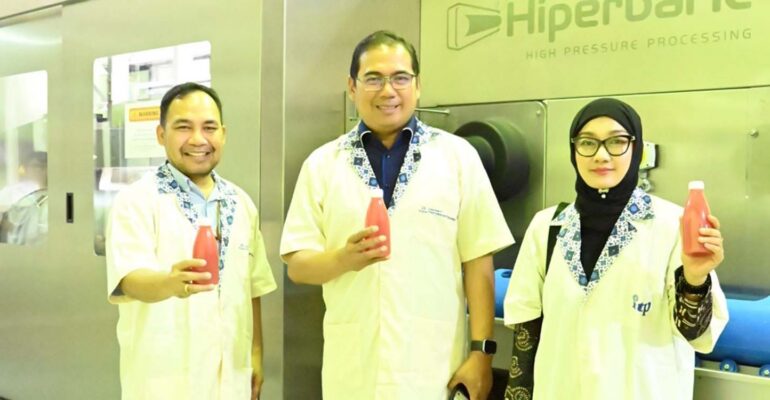
IPB University continues to strengthen food safety research through the adoption and development of high pressure processing (HPP) technology. This technology represents a new approach to food processing because it can inactivate microorganisms without relying on intense heating.
“IPB is driving the development of food processing innovations that are more adaptable to industry needs, while aligning with the agenda of downstream processing of agricultural products and the development of sustainable future food technologies,” said IPB University Rector Dr Alim Setiawan.
Given its mechanism of action, HPP is considered relevant for the modern food industry, which demands products that are safe, high quality, nutritious, and retain their fresh characteristics. In its application, HPP uses pressures of up to approximately 600 MPa, equivalent to 87.000 psi.
“High pressure applied uniformly to food products can damage cell membranes, increase the leakage of intracellular components, alter the structure of proteins and enzymes, and inhibit metabolic processes and cell division,” stated Prof Azis Boing Sitanggang, Professor of Functional Food Process Engineering, Division of Food Science and Technology, Faculty of Engineering and Technology, IPB University.
Prof Azis explained that this mechanism allows pathogenic and spoilage microorganisms to be inactivated without relying on high heat. HPP has been reported to reduce microbial counts in milk, cheese, yogurt, and reconstituted milk.
“At a pressure of 600 MPa, this technology can reduce pathogens such as Escherichia coli and Listeria monocytogenes by 3 to 5 log in fresh milk, while extending the refrigerated shelf life to 60 days,” he said.
In addition to supporting food safety, HPP also has the potential to preserve nutritional quality and product characteristics. This technology is reported to retain over 90 percent of essential vitamins, including vitamins A, vitamins B group, vitamins C, D, and E, as well as important minerals such as calcium and phosphorus. HPP can also help maintain the pH, viscosity, color, and taste of milk, making it better aligned with consumer preferences.
“At IPB, so far, the application of HPP technology has been studied in the preservation of various juice products, milk, and avocado spreads, and even as a method to assist the gelation process of an emulsion system,” said Prof Azis.
The development of this technology stems from the limitations of conventional thermal processing methods. Since the era of Nicolas Appert in the early 19th century, heating has been the primary method for food preservation through processes such as pasteurization, sterilization, and drying. While effective at suppressing microorganisms, excessive heating can reduce nutritional content and alter the color, aroma, taste, and texture of food.
Nevertheless, the effectiveness of HPP remains influenced by the type of microorganisms, the cycle and level of pressure, process duration, temperature, pH, moisture content, food composition, and the presence of bacterial spores, which are generally more resistant to high pressure. Therefore, Prof Azis noted that the development of this technology must continue to be directed toward suitable product types, quality targets, and achieved shelf life, with production systems that are more efficient, affordable, and compliant with food safety standards.
“IPB is one of only two HPP users in Indonesia. Therefore, IPB strives to promote leading edge food processing innovations in Indonesia, focused not only on safety but also on quality, nutrition, sustainability, and the evolving needs of the food industry,” stated Prof Azis. (*/Rz) (IAAS/SSR)

