IPB University’s Young Researchers Team Studies Mangrove Restoration Program on Java’s North Coast, Receives Support from FINCAPES
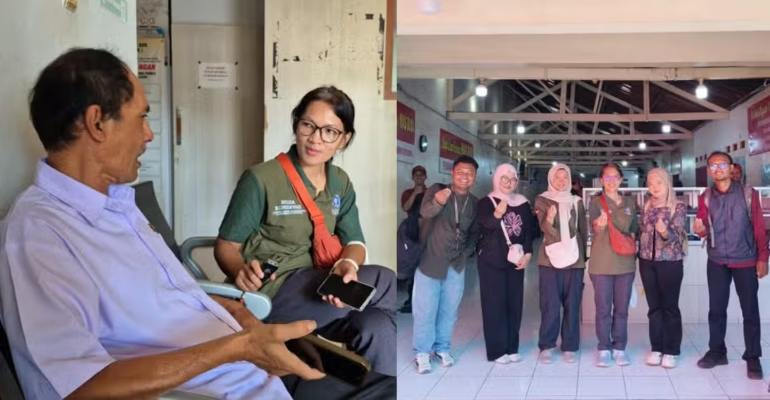
Young researchers from the Center for Environmental Research (PPLH) at IPB University have received support from the Flood Impacts, Carbon Pricing, and Ecosystem Sustainability (FINCAPES) Project to study the Mangrove Restoration Program on Java’s North Coast.
Broadly speaking, this initiative aims to help design mangrove rehabilitation efforts tailored to local conditions. The project, located along the Indramayu coast, seeks to integrate physical data (such as sedimentation, bathymetry, and shoreline changes), ecological data (water and substrate quality), and local community conditions.
FINCAPES itself is an international research collaboration program focused on climate change, regional resilience, and ecosystem management. Through funding schemes such as I-CAN Sync, FINCAPES supports collaboration among universities, research institutions, and relevant partners to produce relevant and practical research.
“This activity runs from August 2025 to August 2026. The study area is located along the Indramayu coastline, particularly around the Cimanuk River Basin (DAS),” explained Tarisa Fadilah, ST, a representative of the IPB University PPLH.
Activities include socioeconomic surveys of communities in six villages and the collection of biophysical data at several locations, such as the Waledan, Cangkring, and Tiris Beach coastlines.
The research involved a team of experts from several institutions, namely IPB University, the National Research and Innovation Agency (BRIN), the Bandung Institute of Technology, and the Institute of Technology of Cambodia, as part of an international collaboration.
In the next phase, coordination will also be carried out with the Indramayu Environmental Agency (DLH), the West Java Environmental Agency (DLH), and the Cimanuk-Citanduy Watershed Management Agency (BPDAS) to ensure that the research results are relevant to the needs of the relevant stakeholders.
Dr Yudi Setiawan, Chairman of IPB University’s PPLH, noted that the programs and activities carried out by PPLH are not only focused on studies related to environmental permitting. Rather, they also encompass collaborative research with research institutions, universities, and international environmental organizations concerned with issues such as climate change, ecosystem restoration, and socio-environmental matters.
“The joint activities with FINCAPES, supported by domestic and international universities as well as research institutions such as BRIN, are expected to expand the impact and contribution of IPB University’s PPLH at both the national and international levels,” he emphasized.
He hopes this research will identify priority restoration zones, produce mangrove suitability maps, and generate policy recommendations that local governments can use for future planning.
“The assessment of social aspects is conducted to ensure that the policies resulting from mangrove rehabilitation programs to date are not only scientifically sound but also beneficial and well-received by the local communities that rely on these mangrove resources,” said Dr Yudi. (*/Rz) (IAAS/EPK)