JSF 2026: IPB University Brings Together Researchers from 12 Countries to Discuss Sustainable Megaurbanization
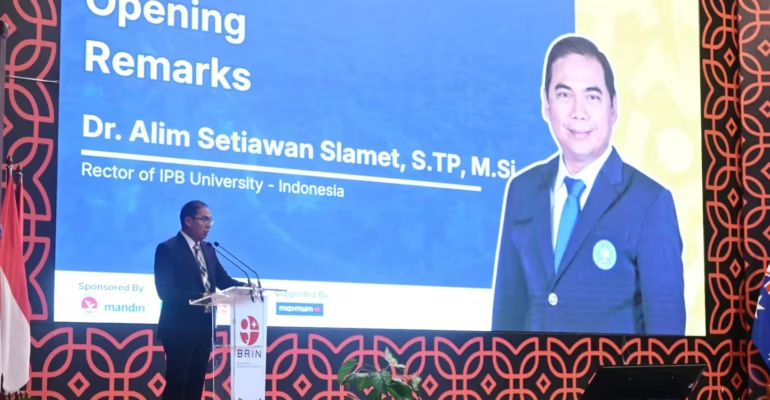
IPB University held The 8th International Conference of Jabodetabek Study Forum (JSF) 2026, which took place in a hybrid format at BRIN Thamrin Convention Hall, Jakarta (June 23–24). With the theme Towards Resilient and Sustainable Mega-Urbanization in the Global South, the conference was attended by 88 participants from 12 countries, including academics, researchers, government officials, and practitioners.
This event was a result of collaboration between IPB University and the National Research and Innovation Agency (BRIN), Graduate School of Global Environmental Studies (GSGES) Kyoto University, as well as the Infrastructure and Regional Development Research Center (PPIW) at Bandung Institute of Technology.
Chairman of BRIN, Prof Arif Satria, noted that the Jabodetabek area has developed into one of the largest mega-urban regions in the world, thus requiring increasingly adaptive and inclusive governance.
According to him, various urban issues, ranging from the informal sector to the environment, must be addressed comprehensively through a collaboration between technocratic approaches and practices that develop within the community.
“The informal sector is not a threat. It should actually be integrated into the formal economic system. This inclusive principle will be very important for making megacity areas more sustainable,” he explained.
Meanwhile, the Rector of IPB University, Dr Alim Setiawan Slamet, emphasized that the rapid urbanization in the Global South brings multidimensional challenges that cannot be solved sector by sector.
“These various challenges cannot be resolved by a single discipline or a single institution alone. We need an integrated approach that combines the excellence of science, evidence-based policy, technological innovation, and close collaboration between universities, the government, industry, and the community,” he said.
He added, “As an institution with global leadership in agriculture and environmental sciences, IPB University believes that sustainable urban development must be built on the foundation of ecological resilience through strengthening food systems, protecting water resources, conserving biodiversity, and developing inclusive regions.”
The Vice Rector of IPB University for Research, Innovation, and Agromaritime Development, Prof Ernan Rustiadi, explained that the JSF event is an academic tradition that has been held eight times and has now evolved into an international collaboration platform for studying metropolitan dynamics.
“Jabodetabek has now become the largest megacity in the world. Therefore, moving forward, the JSF team will further strengthen networks with researchers across countries to develop studies on mega-urbanization in the Global South,” he explained.
According to Prof Ernan, the phenomenon of mega-urbanization is not just related to urban areas, but also involves rural and peri urban regions that are directly affected by metropolitan growth. Therefore, studies on mega-urbanization need to be carried out comprehensively, involving various disciplines.
On that occasion, the Chairman of the Research Center and Planning for Regional Development (P4W) at IPB University, Prof Baba Barus, cited the development of the Cibulao model village as a good example showing how rural areas can play a role in supporting the sustainability of urban regions.
The JSF 2026 conference featured participants from Indonesia, Japan, the Czech Republic, China, the Netherlands, Ireland, Malaysia, Timor-Leste, Kenya, and Zimbabwe. (AS) (IAAS/HNF)