Through National Jamu Day 2026, IPB University Strengthens Research Based Jamu Downstreaming
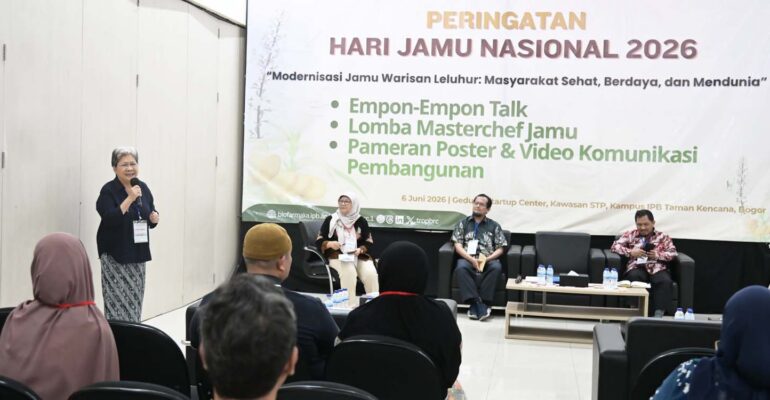
IPB University, through the Center for Tropical Biopharmaceutical Studies, commemorated National Jamu Day 2026 with a series of educational activities themed “Modernizing Ancestral Jamu Heritage, A Healthy, Empowered, and Global Community,” held at the Startup Center Building, Taman Kencana Campus, Bogor (6/6).
This event served as a platform for collaboration among academics, researchers, students, industry representatives, and the community to strengthen the role of herbal medicine as both a cultural heritage and a future health innovation.
The Event Chair, Dr Ninuk Purnaningsih, stated that the commemoration of National Herbal Medicine Day is a moment to reflect on Indonesia’s biological wealth and local knowledge that has been passed down through generations.
According to her, the current challenge is how to develop traditional herbal medicine in a more scientific, innovative, and relevant manner to meet the needs of modern society.
“Traditional herbal medicine, as the nation’s cultural heritage, still holds a central place in the lives of the Indonesian people. Through this event, we are creating a space for learning, sharing experiences, and collaboration so that the use of traditional herbal medicine becomes more appropriate, safe, and beneficial for the community,” she said.
She added that the Center for Tropical Biopharmaceutical Studies will continue to strengthen research and the commercialization of herbal products based on Indonesia’s biological resources.
She noted that the potential of Indonesia’s biodiversity must be supported by robust scientific evidence so that jamu gains broader public acceptance and can evolve into high value health products.
“Generation Z, Generation Alpha, and future generations need to understand that herbal medicine is not outdated. In fact, with the integration of science and technology, traditional herbal medicine can become a relevant, safe, and globally recognized health solution for the future,” she added.
The Chairman of the Center for Tropical Biopharmaceutical Studies at IPB University, Prof Mohamad Rafi, emphasized that National Traditional Herbal Medicine Day holds strong historical significance for the development of traditional herbal medicine in Indonesia.
“Herbal medicine doesn’t mean it’s old fashioned. We can modernize traditional herbal medicine into something capable of maintaining health and protecting the public through a strong scientific approach,” said Prof Rafi.
He also noted that the Center for Tropical Biopharmaceutical Studies at IPB University continues to contribute to research, education, and community service to support the development of herbal medicines based on Indonesia’s biological resources.
Meanwhile, the Chairperson of the International Research Institute for Food, Nutrition, Health, and Halal (LRI PGKH) at IPB University, Prof Erika Budiarti Laconi, emphasized the importance of bringing Indonesian herbal medicine innovations to the global stage through research collaboration, industry partnerships, and international promotion.
She hopes that National Jamu Day activities can become a regular annual event capable of expanding the utilization of jamu research results to both national and international markets.
For your information, this event was attended by more than 150 talk show participants. Additionally, 100 students participated in a poster exhibition and educational herbal medicine videos, as well as the MasterChef Jamu competition. The various events held also included free health checkups, the Empon-Empon Talk, and an exhibition of development communication works themed around herbal medicine education. (dr) (IAAS/WSG)