IPB University Strengthens National Energy Transition Through Research and Innovation Based on Biological Resources
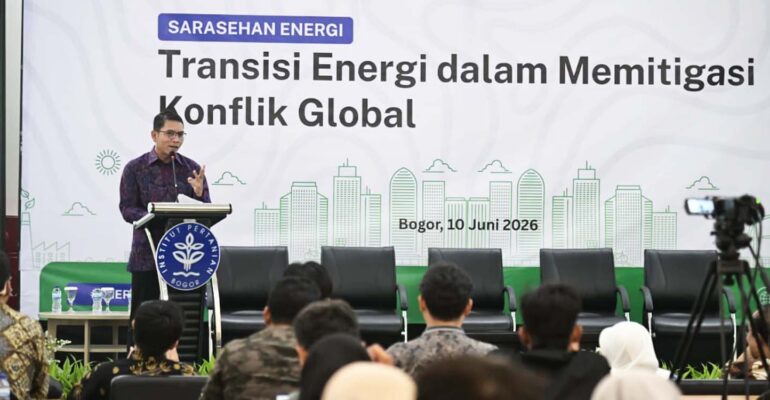
To strengthen the national energy transition based on science and innovation, IPB University held an Energy Symposium themed “Energy Transition in Mitigating Global Conflicts” at the Startup Center Building, Taman Kencana Campus, Bogor (6/10). This event aimed to enhance understanding and foster synergy among stakeholders in the implementation of national energy policies.
Dr Heti Mulyati, Vice Rector for Resource and Infrastructure Resilience at IPB University, stated that global geopolitical dynamics including rising international tensions affecting energy supply chains make the energy transition an agenda that cannot be postponed.
According to her, energy security is closely linked to national security, sustainable development, and social justice.
“As an agromaritime-based university, IPB University possesses strong research capabilities to support the energy transition through the development of biomass, bioenergy, biomaterials, bio-resource based process technologies, and sustainable energy policies,” said Dr Heti.
Dr Heti continued, noting that IPB University is currently developing an Agri-Photovoltaic project in collaboration with South Korea through solar power generation facilities at the Dramaga Campus and the IPB University School of Business as a model for integrating agricultural land with renewable energy.
Meanwhile, the Secretary General of the National Energy Council, Dr Dadan Kusdiana, emphasized that this forum is part of the Minister of Energy and Mineral Resources’ directive to directly communicate to the public the national energy policies currently being implemented by the government.
According to him, the energy sector is closely linked to food security. “The energy sector is closely linked to the agricultural sector. Indonesia requires approximately 9 million tons of fertilizer annually, and fertilizer is produced using natural gas. This means that energy security directly supports food security.”
Therefore, he emphasized, “collaboration with IPB University is highly strategic, whether in the development of biofuels, biomass, or bio-based energy innovations.”
He added that the government also hopes IPB University will continue to contribute to the development of bioethanol, biogas, biomass, wood pellets, and co-firing technology as part of accelerating the national energy transition.
According to him, the utilization of biomass has the potential to create millions of tons of new raw material demand, generate employment, reduce carbon emissions, and simultaneously boost the economic value for communities.
Dr Satya Widya Yudha, a member of the National Energy Council’s Stakeholder Group, added that IPB University’s research findings have helped accelerate the implementation of the B40 program through road tests covering 50.000 kilometers, the development of quality standards, and engine performance evaluations.
He noted that Indonesia’s Energy Security Index for 2025 reached 7,13 on a scale of 10, an increase of 0,39 points compared to 2024. Meanwhile, biodiesel production has reached 14,2 million kiloliters, reducing diesel imports by 3,3 million kiloliters and potentially saving approximately Rp49,5 trillion in foreign exchange.
In his presentation, Dr Satya also revealed that Indonesia still faces major challenges, including liquefied petroleum gas (LPG) imports accounting for about 80,6 percent of domestic consumption, crude oil imports at 38,7 percent, and fuel imports at 34,2 percent of national demand.
Therefore, he urged the acceleration of B50 implementation, the development of second-generation bioethanol (biomass) and microalgae, as well as artificial intelligence based smart grids, as part of the strategy toward energy sovereignty. (dr) (IAAS/LAN)