IPB University Promotes Community Based Management of Lobster Larvae to Strengthen the National Blue Economy
IPB University, together with stakeholders in the fisheries sector, is promoting community based management of lobster larvae as a strategy to strengthen the national blue economy while improving the welfare of fishermen.
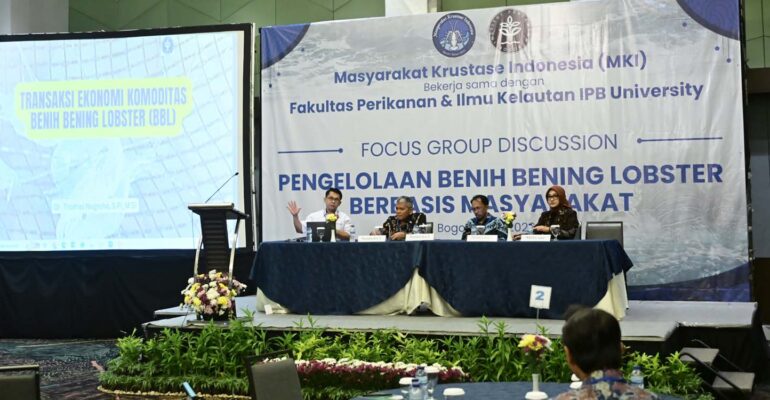
This initiative was presented during a focus group discussion (FGD) at the IPB International Convention Center in Bogor on (6/1), which addressed plans to revise Ministerial Regulation on Marine Affairs and Fisheries (Permen KP) No 5 of 2026 regarding the management of crustacean commodities, particularly lobsters.
The Chairman of the Indonesian Crustacean Society (MKI) and Professor at the Faculty of Fisheries and Marine Sciences, IPB University, Prof Sulistiono, stated that MKI supports the government’s policy direction in strengthening the management of crustacean commodities.
However, he noted that policy implementation must take into account the readiness of aquaculture practices, technology, and infrastructure available on the ground.
“We at MKI support the government’s strategic policy direction in strengthening the management of crustacean commodities. However, the reality on the ground shows that the readiness of aquaculture, technology, and infrastructure is not yet fully adequate,” he said.
According to Prof Sulistiono, Indonesia needs to strengthen national lobster hatcheries to improve the survival rate of farmed lobsters.
Currently, the survival rate of lobsters in Indonesia remains between 10–30 percent. By comparison, Vietnam has now reached approximately 85 percent.
Therefore, he emphasized that the development of aquaculture technology and collaboration between the government, the private sector, and universities is an urgent necessity.
In line with this, the Dean of the Faculty of Fisheries and Marine Sciences (FPIK) at IPB University, Dr Beginer Subhan, emphasized that Indonesia possesses highly potential lobster resources capable of supporting the national economy and improving the welfare of coastal communities
He explained that the presence of both sand lobsters and pearl lobsters constitutes a strategic asset that must be managed sustainably.
Therefore, the results of the FGD are expected to serve as a basis for the government in formulating more effective policies for the management of BBL in Indonesia.
Meanwhile, Senior Expert at the Office of the Presidential Staff of the Republic of Indonesia, Febriyantoro, stated that the government fully supports various efforts aimed at improving fishermen’s welfare and preserving the environment.
According to him, community based lobster management aligns with the national blue economy agenda and can be integrated with the Kampung Nelayan Merah Putih program.
Strengthening national aquaculture capacity is also a priority for the Chairman of the Indonesian Aquaculture Society, Prof Rokhmin Dahuri. He noted that Indonesia possesses the world’s largest lobster potential, encompassing seed availability, lobster catch volumes for consumption, and aquaculture opportunities.
“Indonesia has the world’s largest lobster potential, but our aquaculture capabilities still lag behind. Therefore, strengthening national aquaculture must be a priority so that the economic value added is not reaped by other countries,” said Prof Rokhmin. (dr) (IAAS/ASY)